
StakerX Documentation
Understand StakerX and StakerGPT, learn how to fund your account and open a stake, or find answers about daily yield, withdrawals, and referrals.
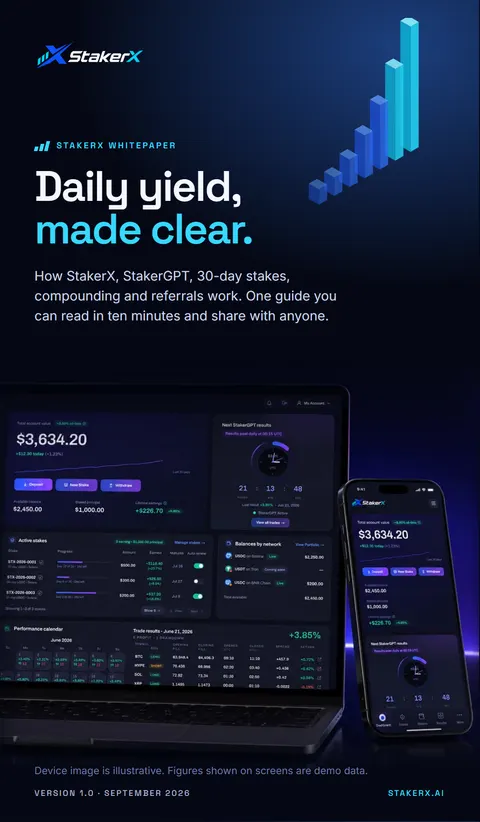
How StakerX works in one short guide: 30-day stakes, daily yield, compounding and referrals.
StakerX overview


Trading and risk model

Using the account


What StakerX is
StakerX is a crypto staking and yield platform built around a simple idea: most users want exposure to automated trading performance without having to watch charts, manage leverage, time futures entries, configure trading software, or learn the mechanics of perpetuals markets.
Instead of asking users to trade directly, StakerX lets users open fixed 30-day stablecoin stakes. The trading work happens inside StakerX through StakerGPT, the internal algorithmic neural trading system that evaluates crypto-perpetuals market data, builds trade candidates, filters them through risk controls, and routes approved setups through StakerX's trading operation. The user experience remains straightforward: fund the account, open a stake, receive daily yield, and decide whether to withdraw or re-stake.
StakerX is not validator staking. The daily profit model is connected to StakerX's internal crypto-perpetuals trading operation, not to blockchain validator emissions. Its return profile, risk controls, and account experience are built around trading performance and treasury management rather than validator participation.
How StakerX works
Using StakerX is designed to be understandable even with no trading background. The user provides stablecoin capital, StakerX runs the internal trading engine, and the account dashboard displays the stake, yield history, maturity date, available balance, and referral rewards.
- Create an accountRegister or log in and enter the StakerX account dashboard.
- Deposit cryptoSend USDC on Solana directly, or deposit USDC, USDT, BTC, ETH, SOL, BNB, TRX and more from Solana, Ethereum, Tron, BNB Chain, Base and other major networks. Whatever you deposit is converted to USDC on Solana and credited to your balance.
- Open a 30-day stakeChoose an amount from $10 upward and start a fixed 30-day staking cycle.
- Receive daily yieldEach active stake follows its own rolling 24-hour schedule from activation; there is no single platform-wide payout time.
- Use available balanceWithdraw daily yield once the available withdrawal balance reaches $10, leave it in balance, or use it to open another stake. With auto-compound on, that stake's yield is added to the stake instead and unlocks at maturity.
- Choose maturity actionAt day 30, withdraw the principal plus anything compounded into it and any unwithdrawn daily yield, manually re-stake, or keep auto re-stake enabled.
Early access assets and networks
The direct deposit path is USDC on Solana: fast, familiar, and low friction. Beyond it, StakerX accepts USDC, USDT, BTC, ETH, SOL, BNB, TRX and more from Solana, Ethereum, Tron, BNB Chain, Base and other major networks through the deposit window's "Deposit another token or network" option. Whatever you deposit is converted to USDC on Solana and credited to your balance.
Your account balance and stakes are held as USDC on Solana, regardless of what you deposit. You do not need to buy a StakerX token. Withdrawals are always sent as USDC on Solana.
StakerGPT trading results
StakerX publishes StakerGPT trading performance on the Trades page. The Trades page gives users and prospective account holders a dedicated view of the latest StakerGPT result and historical daily performance from June 1, 2026 onward.
Each daily entry summarizes StakerGPT trades for that session, including the crypto-perpetuals market, long or short direction, opening and closing fills, timestamps, spread, return, and a TradingView market link. The public results page is separate from the account dashboard so users can review StakerGPT activity without needing to manage trades themselves.
StakerGPT trading results show internal trading performance. Active user stakes receive yield under the public StakerX daily-profit model.
Daily profit model
StakerX's internal trading operation is designed to generate more gross performance than it credits to users as daily yield, before the public StakerX yield model, reserves, referrals, operating spread, and risk buffers are accounted for.
Users do not receive the raw internal trading result directly. Active user stakes receive average daily yield from 1% to 3%, credited every 24 hours. The gap between internal performance and posted daily yield gives StakerX room to manage liquidity, referrals, reserves, operations, lower-performance days, and drawdown protection.
For visibility into StakerGPT's daily trading activity, users can review the StakerGPT Trades page. That page shows trade-level summaries and historical performance, while this section explains how those internal results relate to the account yield model.
| Layer | Purpose |
|---|---|
| StakerGPT performance | Gross trading output generated by the StakerX algorithmic neural trading operation. |
| User daily yield | Average 1% to 3% daily yield credited to active stakes every 24 hours. |
| Treasury spread | Difference used for liquidity, reserves, referral obligations, operations, and risk buffers. |
The 30-day staking cycle
Choose at least $10 from your available balance to open a stake. That amount stays locked for 30 days. Your first daily yield is due after 24 complete hours.
Your chosen amount begins its 30-day term.
Your auto-compound setting decides where it goes.
The stake amount unlocks, including compounded earnings.
Choose where your daily earnings go
Auto-compound on Default for new stakes
Earnings after the performance fee are added to the stake. They earn alongside your original amount and unlock when the stake matures.
Auto-compound off
Earnings after the performance fee go to available balance. You can withdraw once your available withdrawal balance reaches $10, or use them for another stake.
You can change this setting at any time. Turning it off affects future yield; it does not unlock earnings already compounded. Existing stakes keep their own setting.
Auto re-stake is a separate choice. It starts a new 30-day stake when this one ends. Check it before maturity if you plan to withdraw. How re-staking works.
Funding a StakerX account
You can fund your account two ways. The direct path is sending USDC on Solana to your personal deposit address. You can also deposit USDC, USDT, BTC, ETH, SOL, BNB, TRX and more from Solana, Ethereum, Tron, BNB Chain, Base and other major networks: choose "Deposit another token or network" in the deposit window, pick your token and network, and send to the address it shows. Whatever you deposit is converted to USDC on Solana and credited to your balance. Once the deposit is credited, you can open a 30-day stake from the dashboard.
Network and routing costs for converted deposits are taken in transit; what arrives is credited under your account's normal deposit fee schedule, the same as a direct deposit, and StakerX adds no extra fee for converting. You need at least $10 credited to open a stake. Sending exactly $10 may leave you below that minimum after fees; check the sending fee and the estimated amount that will arrive. Withdrawals are always sent as USDC on Solana.
Before you send: match all three
Example for a direct USDC deposit. Copy the real address from your own StakerX account.
In StakerX: Deposit
- Token
- USDC
- Network
- Solana
- Address
- Your personal deposit address
In your wallet or exchange: Send
- Token
- USDC
- Network
- Solana
- Send to
- Paste that same address
A matching token name alone is not enough. Always use the network shown in your StakerX deposit instructions.
How to make a deposit
- Choose your deposit pathOpen Deposit. For USDC on Solana, use your personal deposit address. Otherwise, choose "Deposit another token or network" and select the token and network you have.
- Send to the address shownEach address accepts exactly the token and network it was issued for: your personal address takes USDC on Solana, and an other-token address takes the token and network you picked. Assets sent to the wrong address on the wrong network cannot be recovered.
- Balance updates automaticallyDirect USDC deposits usually credit within about a minute. Converted deposits are credited once routing completes, usually within minutes depending on the source network.
Don't hold USDC on Solana? No swap service needed: choose "Deposit another token or network" in the deposit window and send what you already hold. Whatever you deposit is converted to USDC on Solana and credited to your balance.
Daily yield
While a stake is active, StakerX credits average daily yield from 1% to 3% every 24 hours. This yield is visible in the account dashboard. Where it lands depends on one per-stake setting: with auto-compound off it increases the user's available balance, and with auto-compound on it is added to the stake itself.
Auto-compound
Auto-compound adds each day's yield to the stake instead of your available balance, so the following day earns on a slightly larger amount. The StakerGPT Performance Fee is unchanged: it comes off the gross yield first, and only the net is added to the stake.
New stakes opened from the stake window have auto-compound switched on, shown as a checked option you can untick before confirming. Stakes opened before that are unaffected and stay off until you turn them on. Each stake carries its own setting and you can change it at any time.
Compounding is where the extra growth comes from. Each day's net yield joins the stake, so the next day earns on a slightly larger amount, and that effect builds on itself for the rest of the term. At the same daily rate, a stake left compounding for a full 30 days finishes ahead of the same stake paying its yield out each day, and the longer you keep renewing, the more that gap widens.
Switching it on applies from that point forward: yield already due before you turned it on goes to available balance as usual, and turning it off and on again does not go back and add earlier days.
When daily yield is credited
Each stake follows its own rolling 24-hour schedule from the moment it is activated. Its first yield credit becomes due after 24 complete hours, with later credits due at each 24-hour anniversary. There is no single daily payout time shared by all users.
For example, a stake activated at 3:17 PM has its first yield credit due at 3:17 PM the next day. If you open stakes at different times, each stake can receive yield at a different time. Processing runs in short intervals, so the visible balance update may follow the exact due time by a few minutes; transaction details preserve the exact effective time.
Why StakerGPT results and your daily yield can differ
StakerGPT trading results show the internal trading operation's performance, which is not the same as your daily yield, and the two are expected to differ by design. Active user stakes receive average daily yield of 1% to 3%, credited every 24 hours at the applied StakerX rate shown in your dashboard. Your yield is not the raw internal trading result passed straight through: StakerX credits its own applied rate, and the difference between internal performance and posted yield is a deliberate operating spread, not a discrepancy or a shortfall. That spread is what funds liquidity, reserves, referral rewards, platform operations, risk buffers, and lower-performance days.
Because your yield is credited at the applied StakerX rate, a strong or weak StakerGPT trading day does not pass straight through to your balance. The Daily profit model section covers this layered relationship in full.
Worked example
| Active principal | $1,000.00 |
|---|---|
| Applied daily rate | 2.00% |
| Gross daily yield | $20.00 |
| StakerGPT Performance Fee | 5% of $20.00 = $1.00 |
| Net account gain | $19.00 |
The customer's applied rate, gross credit, performance fee, and net gain appear in the dashboard and transaction details. The operating spread between internal results and customer daily yield supports liquidity, reserves, referral obligations, platform operations, risk buffers, and lower-performance periods. It is not presented as a mechanical daily allocation among those categories.
Yield already withdrawn during the stake cycle is not paid again when the stake matures. At maturity, the original principal unlocks together with any posted yield from that stake that remains in the user's available balance.
Withdrawing funds
Withdrawals are always sent as USDC on Solana. You can withdraw once your available withdrawal balance reaches $10. This balance can include earnings, credited referral rewards, and stake funds that have unlocked.
- Find your receiving addressIn your wallet or exchange, open Receive or Deposit, choose USDC, and select Solana. Confirm that your provider accepts USDC deposits on that network.
- Open Withdraw in StakerXEnter the amount and paste the receiving address. Check the address, any fee, and the final amount before confirming.
- Confirm and trackIf withdrawal confirmation is enabled, enter your one-time code. Eligible withdrawals are sent automatically and typically arrive within a minute. Check the withdrawal status in your account activity.
Want the money in your bank? StakerX sends crypto to your receiving address. Selling or converting it and withdrawing to a bank is a separate step with your exchange or provider, subject to its supported services and fees.
Active stake funds stay locked until maturity, including earnings already added through auto-compound. Turning auto-compound off sends future yield to available balance. Compare the settings.
Still waiting for a transfer? Check these steps and contact support.
Manual re-stake and auto re-stake
Re-staking lets users continue the staking cycle without needing to start from a new external deposit. At maturity, the user's principal unlocks with any unwithdrawn daily yield from that stake. A user can manually open another stake from available funds, or use auto re-stake at maturity.
Auto re-stake is useful for users who want matured funds to continue into another 30-day cycle. Manual re-stake is useful for users who want to choose the exact amount or timing themselves.
Referral rewards
StakerX includes a direct referral program. When a referred user opens an eligible stake, the referrer can earn a referral reward based on the size of that individual stake, as long as the activity is legitimate. The reward is credited to the referrer's account balance when the referred stake activates, subject to eligibility and anti-abuse checks. Referral rewards also apply when that referred user opens another eligible stake later, including a manual re-stake.
| Referred-user stake size | Referral reward |
|---|---|
| $10 - $5,000 | 5% |
| $5,001 - $10,000 | 7% |
| $10,001 - $50,000 | 8% |
| $50,001 - $100,000 | 10% |
| $100,001+ | 15% |
Self-referrals are not allowed. StakerX can block obvious self-referrals and review suspicious referral activity such as repeated wallet reuse, circular referral behavior, or other abuse patterns.
Account security and 2FA
StakerX accounts sign in with email one-time codes, Google, or linked Solana wallets, in any combination. The Settings page adds three layers of protection on top of sign-in: a verified recovery email, a verified security phone, and one-time withdrawal confirmation codes.
Withdrawal confirmation
Withdrawal confirmation protects the action that matters most. Once enabled, every withdrawal requires a fresh one-time code before it is sent, delivered to your verified email or, if you enroll a security phone, by SMS.
- Open Settings, then Account securityThe security card sits in your account settings alongside your login methods.
- Optionally enroll a security phoneAdd your phone number and confirm it with an SMS code. The phone is optional; without it, confirmation codes arrive by email.
- Turn on withdrawal confirmationChoose email or SMS as the delivery channel. From then on, each withdrawal asks for a fresh one-time code before it is sent on-chain.
A note on what each channel gives you: with a verified security phone, SMS confirmation is an independent second channel, two-factor protection in the proper sense. A code sent to the same email you sign in with is action-specific confirmation rather than independent 2FA: it still stops a stolen session from sending a withdrawal, but not an attacker who also controls your email. If you have both channels verified, prefer SMS.
Recovery email and email changes
Accounts created with only a wallet can add one verified recovery email from Settings, which enables email sign-in and code delivery. Changing an existing email is deliberately guarded: codes are confirmed on both the current and the new address, a cooldown applies, and other active sessions are signed out, so a briefly unattended session cannot quietly re-point your account.
Two habits cover most of account security here: keep your recovery email current, and leave withdrawal confirmation switched on.
Reading your dashboard
Different totals answer different questions. Check activity to see the deposits, earnings, fees, and withdrawals behind them.
- Available balance
- Funds outside your active stakes. The withdrawal window shows your available withdrawal amount.
- Active stakes
- Amounts committed to a term, including earnings added through auto-compound.
- Lifetime earnings
- Your running earnings total. It is different from your current balance and does not reset when you withdraw.
- Next yield and maturity
- When the next earnings credit is due, and when the stake finishes its 30-day term.
StakerGPT
StakerGPT is StakerX's own automated trading system. It reviews crypto markets, identifies potential trades, and checks them against trading rules before they can be placed.
StakerX is among the limited number of organizations with access to Claude Mythos. StakerGPT combines Claude Mythos access, a Claude Opus-family reasoning model, Mythos-guided strategy logic, historical market analysis, live market inputs, deterministic execution rules, and risk controls. The model layer helps interpret market structure and strategy context; the rule layer decides whether that interpretation is specific enough, measurable enough, and controlled enough to become an executable signal.
StakerGPT's trading performance and trade-level results are posted on the site daily. This gives anyone evaluating StakerX a clear view of StakerGPT's daily trading activity while keeping strategy execution inside StakerX. The latest result and historical daily summaries are available on the StakerGPT Trades page.
Market context
The system reviews price action, volatility, momentum, liquidity, funding-rate behavior, news context, and broader crypto-sector conditions before a setup is considered.
Strategy reasoning
The neural reasoning layer compares current conditions against the strategy framework, historical market behavior, and prior performance feedback to decide whether a setup is worth developing.
Signal translation
A model opinion is not placed directly into the market. It is converted into rule-based signal data such as market, direction, entry conditions, invalidation conditions, expected reward, and risk assumptions.
Risk filtering
Before execution, the setup is checked against liquidity, volatility, drawdown exposure, position sizing, stop behavior, and abnormal-market filters.
Execution review
Approved trades move through StakerX's internal trading operation, where open positions are monitored and completed trades are reviewed against the model's original thesis.
StakerGPT generates internal trading performance for StakerX. Active stakes receive daily yield under the public StakerX profit model. Users do not need to see every trade, manage leverage, or react to every market move. They see the staking product: active principal, daily yield, available balance, maturity status, withdrawals, re-stakes, and referrals.
Training data and strategy development
A trading model is only useful when it has enough context to understand different market conditions. StakerX's neural trading framework is built around broad market input, strategy education, and continuous performance review.
- Historical crypto price action and volatility behavior
- Perpetuals market structure, liquidity, trend, and reversal patterns
- Funding-rate, momentum, and technical-indicator conditions
- Market news, macro context, and crypto-sector sentiment
- Educational trading material, risk-management frameworks, and strategy rules
- Internal performance feedback from simulation, review, and live trading records
This training process helps the system learn when market conditions are constructive, when a trend is weakening, when volatility is too unstable, and when the expected reward does not justify the risk. StakerGPT is built around repeatable decision quality, controlled exposure, and low drawdown across changing market conditions. The goal is to create a repeatable trading process that can generate daily performance while keeping drawdowns low relative to the gross trading objective.
From market data to daily profits
StakerX separates the trading system from the public StakerX yield model. StakerGPT produces internal trading performance; StakerX credits account yield under the public 1% to 3% daily profit model.
1. Market observation
The system monitors market conditions across supported crypto-perpetuals markets, looking for setups where trend, liquidity, volatility, timing, and risk are aligned.
2. Neural strategy reasoning
StakerGPT evaluates the market context with Claude Mythos access, a Claude Opus-family reasoning model, and Mythos-guided strategy logic, then turns that reasoning into structured trade candidates.
3. Risk filtering
Signals are filtered before execution. Trade size, stop-loss behavior, drawdown exposure, liquidity, and abnormal market conditions are checked before capital is put to work.
4. Execution and monitoring
Approved trades are executed through StakerX's internal trading operation. Open trades continue to be monitored until the exit, stop, or strategy condition is reached.
5. Daily accounting
Trading performance is reconciled internally, then account yield is credited under StakerX's 1% to 3% average daily profit model.
Why the model targets low drawdown
StakerX's trading model is designed around controlled, repeatable daily performance. The system seeks to avoid the common retail-trading failure modes: oversized positions, emotional entries, overtrading, chasing volatility, and holding weak trades after the original setup has failed.
Low drawdown is pursued through a combination of model filtering, trading discipline, treasury spread, and operational oversight:
- Position sizing that limits exposure on any single trade setup
- Stop-loss and drawdown controls designed to cut weak trades early
- Strategy filtering to avoid low-confidence or unstable market windows
- Treasury spread between internal gross performance and user profits
- Reserve planning for liquidity, payouts, referrals, and lower-performance days
- Manual oversight for abnormal market conditions and platform-level risk events
Crypto perpetuals remain active markets with real volatility. StakerX's approach is to trade them through a controlled engine and to credit account yield through a defined daily-profit framework rather than exposing users directly to every trade result.
What are the risks?
Staking with StakerX involves risk, including trading performance risk, technology risk, and regulatory risk. StakerX manages trading risk with the controls described above, plus reserves and an operating spread, but no trading operation is risk-free and neither daily yield nor principal return is guaranteed.
Day to day, your credited balance does not track raw trading results: daily yield is credited at your applied StakerX rate, and drawdown days are absorbed by the operating spread, reserves, and risk buffers. Those buffers exist to carry the platform through lower-performance periods; they are protection, not a guarantee.
The full legal risk statement lives in the Risk Disclosures.
Common questions
Browse by topic, or use search to jump straight to an answer.
About StakerX and StakerGPT
What is StakerX?
StakerX is a crypto staking and yield platform powered by StakerGPT, StakerX's internal agentic crypto-perpetuals trading system. Users deposit USDC or most major tokens (credited as USDC on Solana), open stakes, StakerX operates StakerGPT internally, and active stakes receive average daily yield from 1% to 3% every 24 hours while the account dashboard tracks yield, principal, withdrawals, re-stakes, and referrals.
What is StakerGPT?
StakerGPT is StakerX's proprietary agentic crypto-perpetuals trading system and the decision layer behind the platform. It evaluates market context, combines Claude Mythos access with a Claude Opus-family reasoning model and Mythos-guided strategy logic, turns qualified setups into controlled trade candidates, and routes approved trades through StakerX's internal operation.
Why is StakerX allowing public access to StakerGPT if it is already profitable?
StakerGPT remains proprietary to StakerX. Public users access a managed staking product powered by StakerGPT while StakerX keeps the trading operation internal. Public staking lets StakerX scale the trading treasury, deepen liquidity, grow the referral network, and keep an operating spread between internal trading performance and user daily yield.
Why are balances held in USDC?
You can deposit most major tokens, but every balance and stake is held as USDC on Solana. A stable unit keeps the stake amount easy to understand and separates principal from spot-token price swings while StakerX runs its separate internal trading strategy. Withdrawals are always sent as USDC on Solana.
Can I see what StakerGPT is doing?
Yes. StakerGPT trading performance and trade-level results are posted on the site daily, giving users visibility into StakerGPT's daily activity while protected strategy execution remains inside StakerX.
Where can I see StakerGPT trading results?
StakerGPT trading performance, trade-level StakerGPT summaries, and historical daily results are available on the Trades page.
How does StakerX manage trading risk?
StakerGPT is designed to avoid common retail-trading failure modes such as oversized positions, emotional entries, overtrading, chasing volatility, and holding weak trades after a setup fails. StakerX uses setup filtering, position sizing, stop-loss and drawdown controls, liquidity checks, strategy filters, treasury spread, reserves, and manual oversight for abnormal market conditions.
What are the risks?
Staking with StakerX involves risk, including trading performance risk, technology risk, and regulatory risk. StakerX manages trading risk with the controls described in these docs, plus reserves and an operating spread, but no trading operation is risk-free and neither daily yield nor principal return is guaranteed. The full legal statement lives in the Risk Disclosures.
Do I need trading experience to use StakerX?
No. Users do not manage leverage, time futures entries, watch charts, or configure the trading strategy. You open stakes, track daily yield, and decide whether to withdraw, hold, open another stake, or re-stake available funds.
Is StakerX validator staking?
No. StakerX is not validator staking and does not depend on validator reward mechanics. It is a structured stablecoin staking experience connected to the StakerGPT crypto-perpetuals trading operation.
Stakes and daily yield
Where does the daily yield come from?
Daily yield comes from StakerGPT's internal trading workflow. The system evaluates crypto-perpetuals market context, converts qualified setups into rule-based trade candidates, filters them through risk controls, and routes approved trades through StakerX's internal operation. StakerX then credits account yield under the public 1% to 3% average daily yield range.
What is the minimum stake and how long is each cycle?
The minimum stake is $10. Each stake runs on a 30-day cycle, with daily yield credited every 24 hours while the stake is active.
What is the daily yield range?
Active stakes receive average daily yield from 1% to 3%, credited every 24 hours while the stake is active. The account dashboard shows the actual yield credited for each yield period.
Can my daily yield compound?
Yes. Each stake has an auto-compound setting: with it on, that stake's daily yield (after the StakerGPT Performance Fee) is added to the stake itself instead of your available balance, so the next day earns on a slightly larger amount. Stakes you open from the stake window have it switched on by default, shown as a checked option you can untick before confirming. Stakes opened earlier stay off until you turn them on, and a stake that auto-renews keeps whatever setting its parent had. Compounding is where the extra growth comes from: at the same daily rate, a stake left compounding for a full 30 days finishes ahead of the same stake paying its yield out each day. You can turn it off at any time; yield credited after that goes to your available balance, and anything already compounded stays in the stake until it matures.
When is my daily yield credited?
Each stake follows its own rolling 24-hour schedule from the time it is activated. A stake activated at 3:17 PM has its first yield credit due at 3:17 PM the next day, with later credits due at each 24-hour anniversary. There is no single platform-wide payout time, so stakes opened at different times can receive yield at different times. Processing runs in short intervals, so the visible balance update may follow the exact due time by a few minutes; transaction details preserve the exact effective time.
Are StakerGPT trading results the same as my daily yield?
No. StakerGPT results show the internal trading operation's performance. Your daily yield uses the applied StakerX rate shown in your dashboard and transaction details.
Why is my daily yield different from StakerGPT's daily results?
StakerX maintains an operating spread that supports liquidity, reserves, referral obligations, platform operations, risk buffers, and lower-performance periods. The difference on any one day is not presented as a mechanical allocation among those categories.
How is daily yield calculated?
For a $1,000 active stake at an applied daily rate of 2.00%, gross daily yield is $20.00. The 5% StakerGPT Performance Fee is $1.00, so the net account gain is $19.00. Your applied rate, gross credit, performance fee, and net gain appear in the dashboard and transaction details.
What does Lifetime earnings include?
Lifetime earnings includes net daily yield, credited referral rewards, and credited bonuses, less applicable reversals. Deposits, withdrawals, returned principal, and balance corrections are not earnings. Its percentage is measured against your confirmed deposits, before any withdrawals.
Can my balance go down if StakerGPT has a losing day?
No. Daily yield is credited at your applied StakerX rate rather than passing raw trading results through to your account. Drawdown days are absorbed by StakerX's operating spread, reserves, and risk buffers, which exist to carry the platform through lower-performance periods.
What happens when my 30-day stake ends?
At the end of the cycle, the original stake principal becomes available again with any daily yield from that stake that has not already been withdrawn. Users can withdraw available funds, manually open a new stake, or use auto re-stake.
Deposits and withdrawals
What assets are accepted during early access?
The direct deposit path is USDC on Solana, and you can also deposit USDC, USDT, BTC, ETH, SOL, BNB, TRX and more from Solana, Ethereum, Tron, BNB Chain, Base and other major networks. Whatever you deposit is converted to USDC on Solana and credited to your balance. Withdrawals are always sent as USDC on Solana.
Can daily yield be withdrawn?
It depends on whether the stake is compounding. With auto-compound off, daily yield is added to available balance and can be withdrawn once the available withdrawal balance reaches $10, left in the account, or used to open another stake; withdrawals are processed automatically on-chain and typically land in your wallet within a minute. With auto-compound on, that stake's yield is added to the stake instead, so it stays committed and unlocks at maturity. Stakes you open in the stake window have auto-compound switched on by default, shown as a checked option you can untick before confirming; stakes opened earlier, and renewals of them, keep their existing setting.
Can I withdraw my principal before day 30?
No. Principal stays committed for the full 30-day cycle and unlocks at maturity. Daily yield is different when the stake is not compounding: it is credited to available balance as it is earned, so it can be withdrawn throughout the cycle. Yield added to a compounding stake becomes part of that principal and waits for maturity with the rest.
I sent a deposit. Why is it not showing yet?
Direct USDC deposits usually credit within about a minute. Other tokens must finish transferring and converting first, which usually takes minutes and depends on the network. Check the transfer status in your sending wallet or exchange and confirm that the token and network match your StakerX deposit instructions. If it still has not arrived, contact support with the transaction ID. Do not send another payment just to try to unlock the first. Find help with a transfer
Can I withdraw to my bank or get back the token I deposited?
StakerX sends withdrawals as USDC on Solana to a compatible wallet or exchange address. It does not send a bank transfer or automatically return the original deposit token. If you want bank money, converting or selling the USDC and withdrawing cash is a separate step with your exchange or provider, subject to its availability and fees. Prepare your receiving address
What fees affect the amount I receive?
The StakerGPT Performance Fee is taken from daily yield. The example below uses 5% of the earnings, not 5% of your whole stake. Check the fees and final amounts shown in your account before confirming a transaction. Network fees can also apply. For supported deposits that convert another token to USDC, conversion costs are taken before the funds reach StakerX. See the fee calculation
Referrals
How do referrals work?
Referrers earn 5% to 15% of the staked amount from each eligible stake made by users they invite, credited to the referrer's account balance when the referred stake activates. The rate is based on that individual stake size, so if a referred user opens another qualifying stake later, that new stake can generate another referral reward.
Are self-referrals allowed?
No. Referral rewards are for genuine direct referrals. Self-referrals and abusive referral patterns are not allowed.
Something not looking right?
- Check the statusFor a deposit, look at the transfer in the wallet or exchange you sent from. For a withdrawal, check StakerX account activity and your receiving wallet.
- Check the detailsCompare the token, network, and receiving address with the instructions. A transaction ID (also called a transaction hash) is the reference your wallet or exchange gives a blockchain transfer.
- Contact supportShare the transaction ID, token, network, amount, and approximate time through the official support channel. Never share a seed phrase, private key, password, or sign-in code.
Use the StakerX contact page or the official Telegram account @StakerXSupport. Support will never message you first or ask you to send funds to fix a problem.