
Stakerland guide
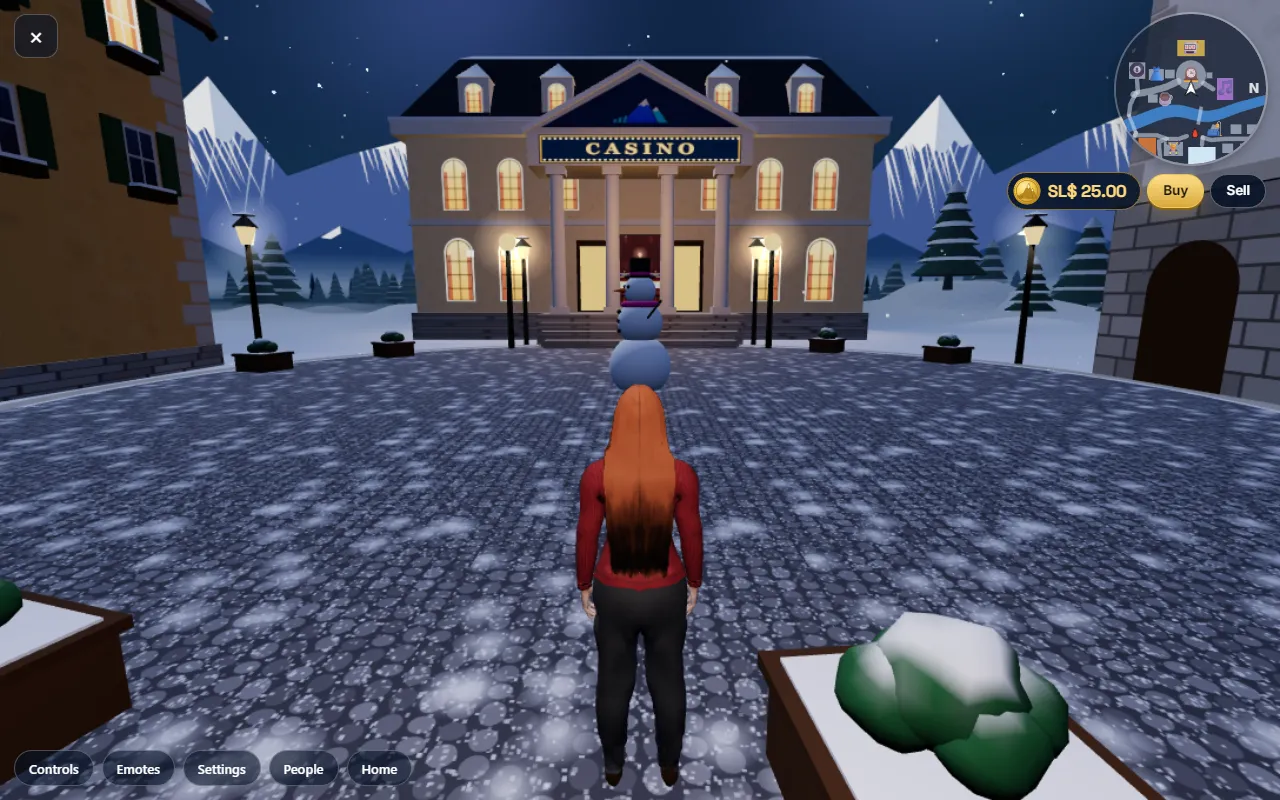
Stakerland is StakerX's optional 18+ 3D social world: a winter town to hang out, chat, dress up and play in, right in your browser. This guide explains how it works, from the door to the casino.
What Stakerland is
Stakerland is a winter town where StakerX stakers hang out, chat, dress up and play together in 3D. It is a separate, optional part of StakerX: you never need to visit it to use StakerX.
It plays in a web browser on a computer, phone or tablet, with nothing to install. Every person you see is another player, apart from the people who work in town: the casino's dealers and croupier, and the café's barista.
Nothing in Stakerland touches your StakerX balance, stakes or yield unless you choose to buy SL$, the Stakerland Dollar, which this guide explains below.
Getting in
Stakerland is free with a StakerX account. When you are signed out, its door has Sign in or sign up: signing in happens on the StakerX site, and you then come back to the door.
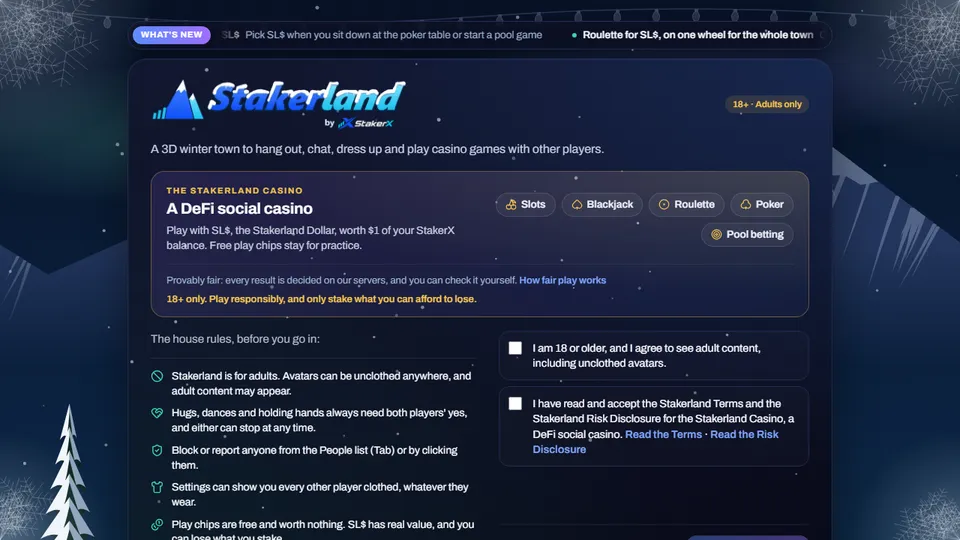
The door is also Stakerland's front page. What's new runs along the top with the latest in town (it pauses while you point at it). Under the Stakerland logo, the casino's block names its five games (slots, blackjack, roulette, poker and pool betting), explains SL$ in a line and links to how fair play works. At the foot are the press that has covered StakerX and links to the Stakerland Terms, the Risk Disclosure and this guide.
Stakerland is for adults. At the door you tick two boxes before the game loads: that you are 18 or older and agree to see adult content, including unclothed avatars, and that you accept the Stakerland Terms and the Stakerland Risk Disclosure for the Stakerland Casino. When the Terms change, the door asks you to accept them again.
Every signed-in StakerX account plays: everyone in the town sees you, and you can move, chat, emote and make friends. The 18+ tick, the Stakerland Terms and Stakerland bans apply to everyone.
On your first visit you create your character: a Stakerland name, a body, a look and clothes. Your name is what other players see over your head. It is 3 to 20 letters or digits, cannot be a link, a wallet address or read as StakerX staff, and you can change it once a week in Settings.
Moving around
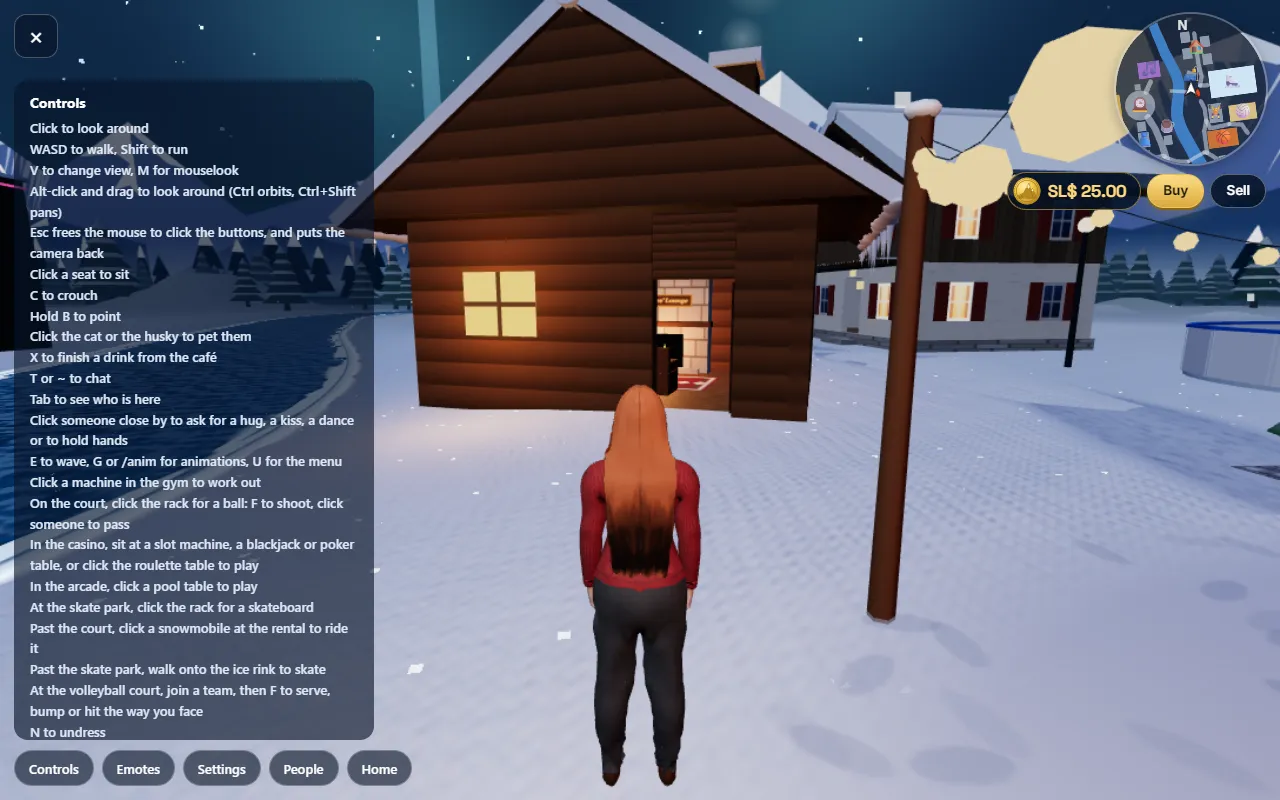
On a computer: WASD to walk and Shift to run, V to change the view, T to chat, Tab to see who is here, U for the menu, and G for animations. Esc frees the mouse so you can click the buttons on screen. H shows or hides the full list of controls.
On a phone or tablet: your left thumb walks (out to the edge to run), dragging on the right looks around, and the round button opens emotes and more.
Click a seat to sit, and a bed, sofa or armchair to curl up or lie down. Press E to wave, C to crouch and hold B to point. Click the cat or the husky to pet them.
M switches mouselook on and off, and Alt-click and drag moves the camera (Ctrl orbits, Ctrl+Shift pans); Esc puts it back. N takes your clothes off and puts them back on, and Y says yes when someone asks you for something.
The round mini map at the top right turns with your view: other players are green dots and your friends yellow ones. Settings has the volume of the sounds and the music, and lets you change your body, hair, skin and eyes at any time.
Settings also has Graphics. Auto, the default, adjusts to your device, or you can choose Low, Medium or High.
The town and its places
Signposts and the town map show where everything is, and the map marks where you are. Every place is free to use.
| Place | What you do there |
|---|---|
| Town square | Where the streets meet. Meet people, and find your way with the signposts. |
| Casino | Slot machines, blackjack, roulette, Texas Hold'em poker and Crash. See The casino below. |
| MC Nightclub | Music and a TV for everyone inside. Change the station with /setstation and put a video on with /tv. |
| Café | Order hot chocolate, a cappuccino, a latte or tea from the barista. Press X to finish your drink. |
| Clothing store | Everything is free to wear. Pick tops, bottoms, shoes or a whole outfit in the fitting rooms. |
| Arcade | Two eight-ball pool tables, alone or against another player, and Snow Grab, a claw machine for play chips. See Pool and pool betting below. |
| The Lodge | The stakers' lounge, by the campfire. |
| Homes | Your own home, which you furnish yourself. The Home button takes you there; step on the doormat or press Go out to come back. |
| Gym | Work out on the machines, then use the open shower. |
| Basketball court, volleyball court, skate park, ice rink and snowmobiles | Sports and rides. See Sports and rides below. |
Chat and commands
Press T or ~ to chat, and Enter to send. What you say is heard by the players near you, as it would be in a real street. A message can be up to 250 characters.
Commands start with a slash. Where a command takes a player's name, you can use the number by their name instead, which helps when two names start the same way.
Type an emoji's name between colons, such as :joy: for 😂; after the first letters, matching emoji are suggested. Some lines show in colour: wins announced to the town in gold, and your own SL$ pool results in green for a win and red for a lost stake.
| Command | What it does |
|---|---|
| Just type | Say it aloud to the players near you. |
| /s or /shout | Shout, heard further away. |
| /l or /low | Speak low, heard only close by. |
| /me | An action, shown as your name followed by what you do (/me waves hello). |
| /w name message | Whisper to one player standing close to you. Only they hear it. |
| /pm name message | A private message to anyone in your copy of the town, however far away. |
| /re message | Reply with a private message to the last player who sent you one. |
| /wre message | Whisper back to the last player who whispered to you. They must still be standing close to you. |
| /afk | Shows [AFK] by your name until you move or type /afk again. |
| /anim | Opens the animations. Add a name to play one, such as /anim pushups. |
| /setstation link | Inside MC Nightclub, plays a zeno.fm radio station for everyone there. /setstation off goes back to the club's own. |
| /tv link | Inside MC Nightclub, puts a YouTube video on the TV for everyone there. /tv off turns it off. |
People, friends and consent
Press Tab, or open People from the menu, to see who is here and how far away they are. You can send friend requests from People; each one needs the other player's yes.
Click someone close by to ask for a hug, a kiss, a slow dance, to hold hands, a playful spank, or a ride on a snowmobile. It happens only when they say yes (Y, or Yes), and either of you can let go at any time. A spank plays once and ends by itself, and you can give one every 8 seconds at most.
The same menu lets you add them as a friend, block them or report them.
Mute, block and report
You can mute, block or report anyone, from the People list (Tab) or by clicking them.
Mute hides a player's chat in this browser. Block goes further: you no longer see them, their chat or their asks anywhere in Stakerland, it is saved to your account, and they are not told.
Report sends StakerX what happened, with a reason and the recent chat of theirs you saw. StakerX reviews every report, and the player is not told who reported them. You can block them in the same step.
StakerLand Support can ban a player who breaks the Stakerland Terms, at once and from inside the game. Everyone in the valley sees a line from StakerLand Support saying who was banned and why. A banned player can appeal, as section 8 of the Terms explains.
Settings can also show you every other player clothed, whatever they wear. Never share your StakerX sign-in codes, wallet details or recovery phrase with anyone in Stakerland: StakerX staff never ask for them.
Gift boxes
Gift boxes are hidden around town. They are free gifts from StakerX, and nobody ever pays to open one.
Opening them is coming soon, so keep an eye out for them. When it arrives, a box may hold a small reward, credited only to an eligible funded StakerX account and within the limits and checks the Stakerland Terms describe.
Sports and rides
Gym: click a machine to work out on the treadmill, the bike, the bench press, the pull-up bar, the punching bag or the dumbbells, then take a shower. Push-ups, sit-ups, squats and other workouts also play anywhere from the animations menu (G or /anim).
Basketball court: click the ball rack to take a ball. Press F to shoot at the nearest hoop, or click another player to pass it to them. Longer shots miss more, and one from beyond the three-point line scores 3.
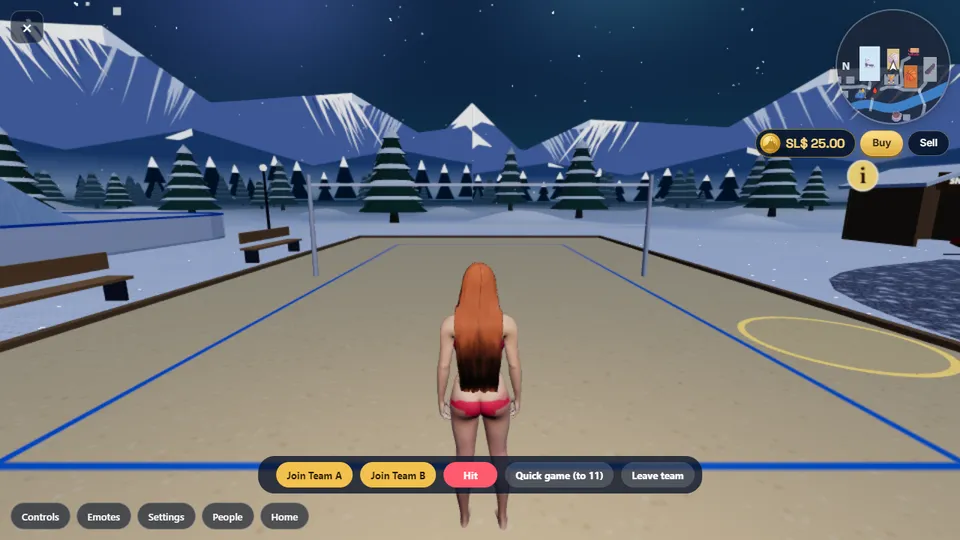
Volleyball court: a sand court east of the gym, on the sports ground by the rink. On the sand, pick Join Team A or Join Team B, up to four a side. Play starts once each team has a player. F, or the Hit button, serves, bumps or hits the ball the way you face. When it is your serve you have 10 seconds before it is served for you.
Each team has three touches to get the ball back over the net. The ball landing in a half scores for the other team; out or into the net, the point goes against the team that touched it last. The first to 15 wins, by two clear points, or to 11 in a quick game. Leave team, or walking well away from the court, takes you out of the game.
Everyone on the sand wears swimwear while they are there, playing or not, and gets their own clothes back as they were on stepping off it.
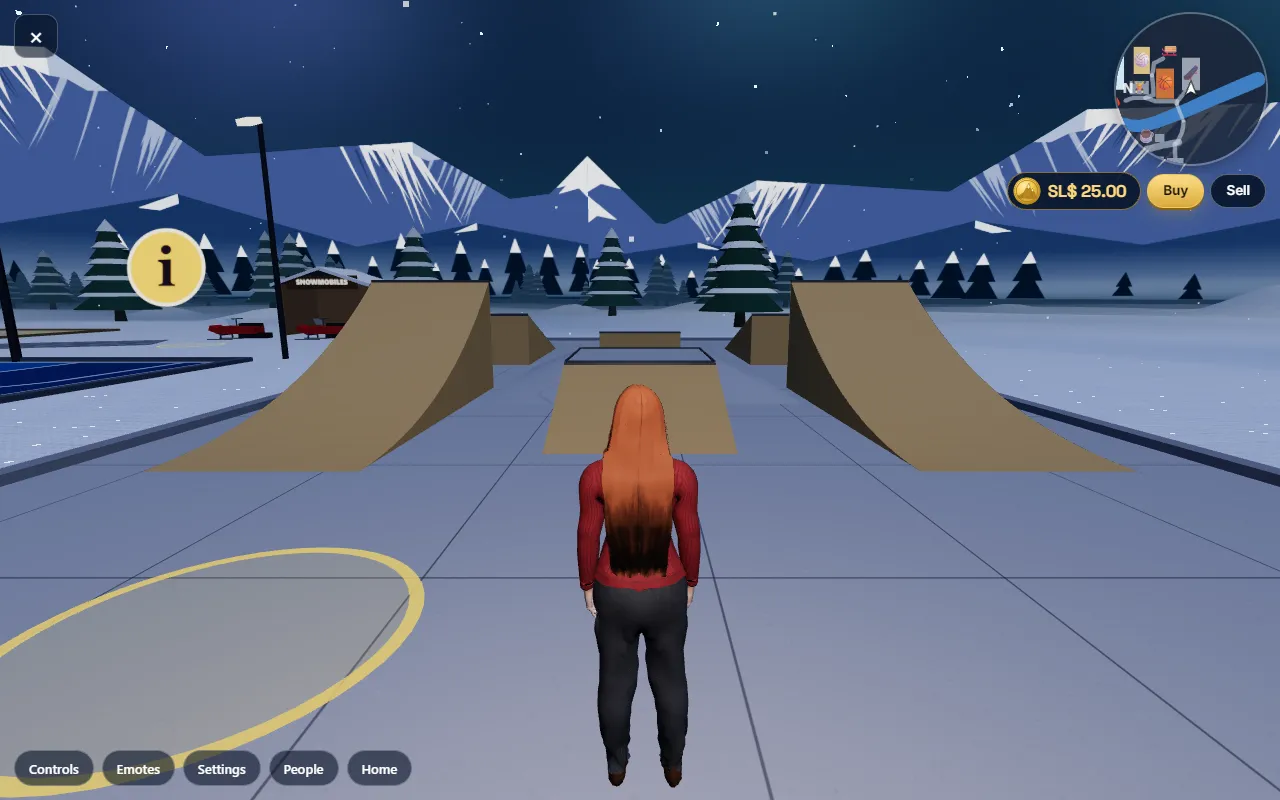
Skate park: click the board rack to take a skateboard. Push, carve, ollie and kickflip round the ramps, and fly off the two big ones. Press Q, or Step off, to walk again.
Ice rink: step onto the ice and your skates go on. Push off, turn and jump, and try the two tall ramps. Leave through the gate to take the skates off.
Snowmobiles: click one at the rental to ride it, free. They are fastest on snow and drag on stone. You can give someone a ride, or ask for one. Get off with Q, or the Get off button.
The casino
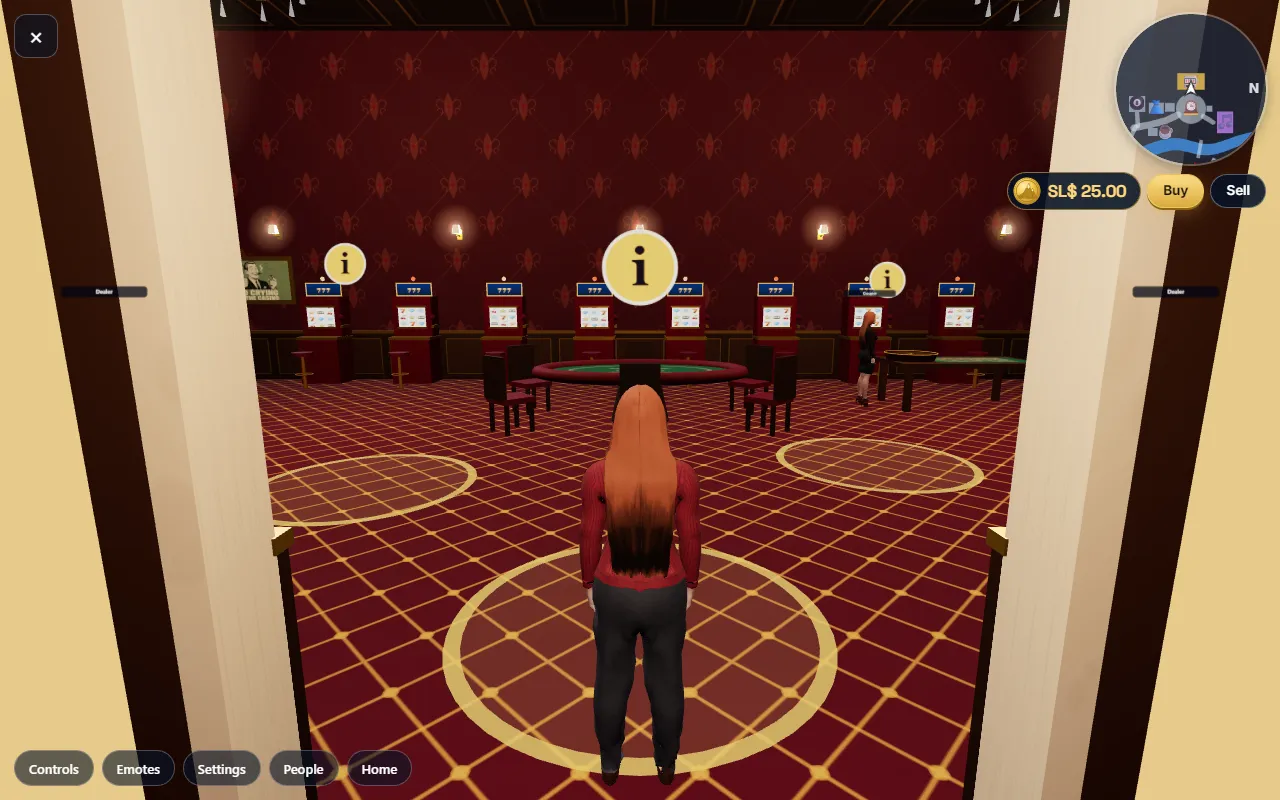
The Stakerland Casino has a row of slot machines, two blackjack tables, a roulette table, a Texas Hold'em poker table and Crash's big screen on the right wall, with dealers at the blackjack tables and a croupier at the roulette. Pool, with its own betting, is in the arcade. Each game has its own section below.
You start with 1,000 free play chips. When you have fewer than 1,000, Top up free brings you back to 1,000. Play chips are kept in this browser, so another browser or device starts its own stack.
Every game can be played with free play chips, which are worth nothing and cannot be bought or cashed out. They are there to practise with.
You can also play for SL$, which has real value. A machine or table plays in one currency, which you choose when you sit down: Play SL$, already picked while SL$ is on for you, or Play chips (free). When your SL$ does not cover the smallest bet, Buy SL$ opens your wallet on its Buy tab. The sections on SL$ below explain what changes when you play for SL$.
Wins at the casino are announced in the chat to everyone in town, in gold, at most one every 8 seconds for each player. An SL$ jackpot is always announced.
Big SL$ wins are also posted in the StakerX Telegram group by @StakerlandBot: a round, hand or pool game that pays out $10 or more, with the winner's Stakerland name, the amount and the game. Wins with play chips are never posted.
Play in your browser
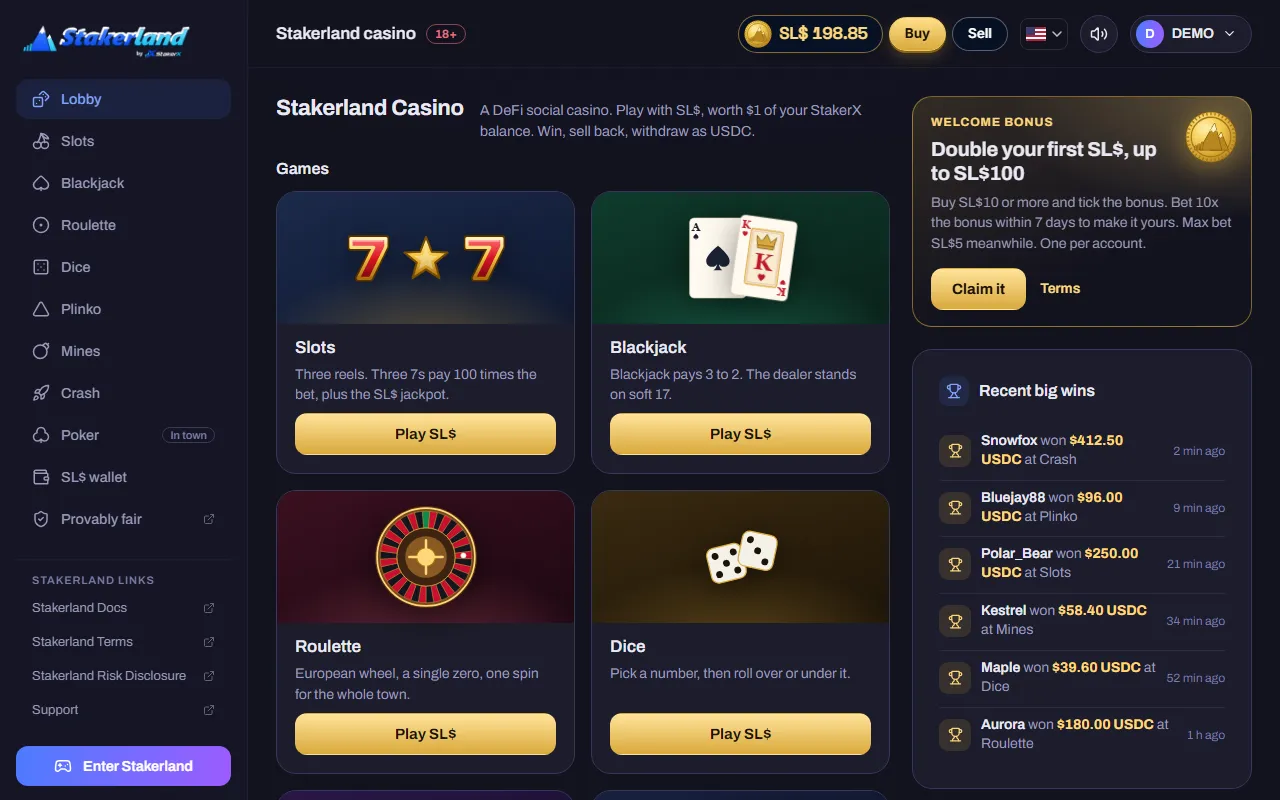
The casino can also be played without the 3D town, on the Stakerland Casino web page: Open Stakerland Casino, among the links at the end of this guide. It is lighter on older computers and phones. Its slot machines, blackjack and roulette work exactly as at the machines and tables in town, and it has Dice, Plinko, Mines and Crash, explained below.
It is the same casino. You pass the same door (signed in, 18 or over, and the Stakerland Terms accepted) the first time you open a game. Your SL$ balance, its history and the Buy and Sell panel are the same ones, at the top of the page, and play chips are this browser's stack, as in town.
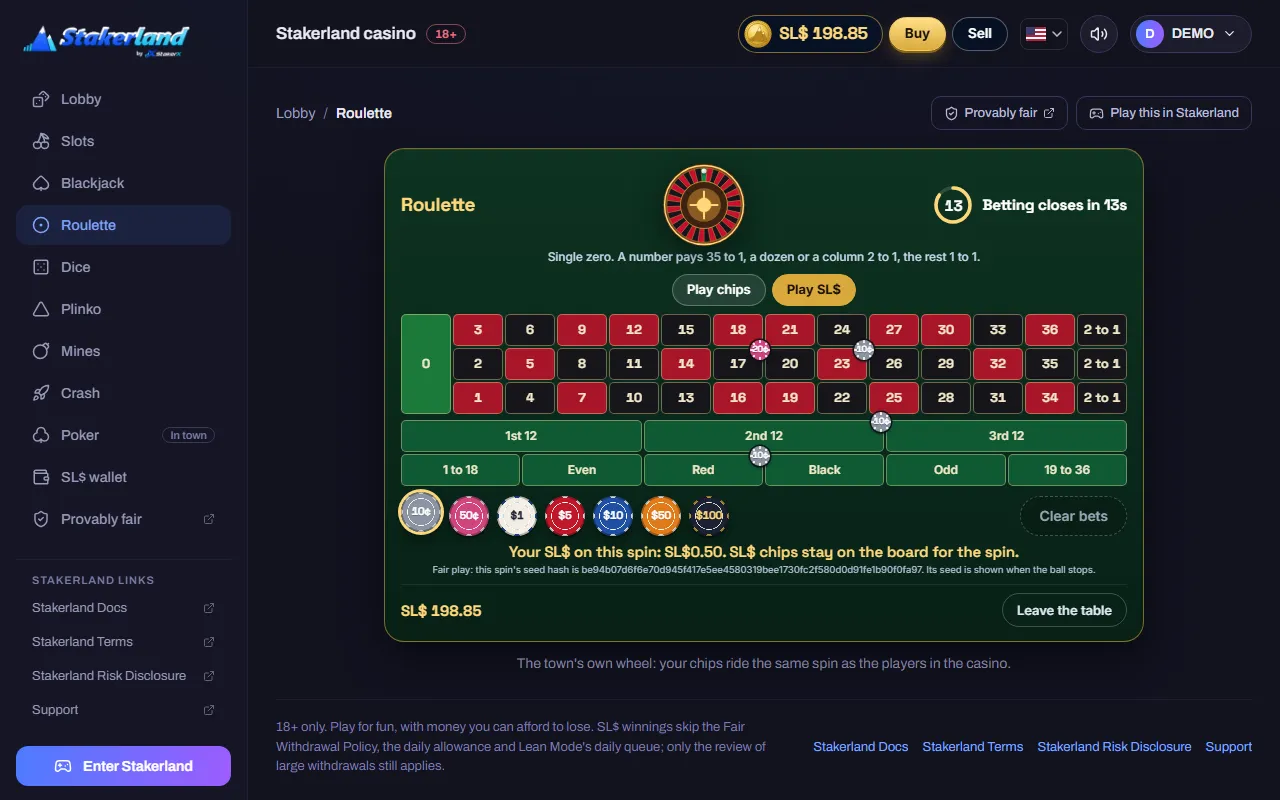
Roulette on the casino page is the town's own wheel: your chips ride the same spin as the players' in the casino, with the same betting clock.
Crash is shared the same way: the page and the screen in the 3D casino show one round, and everyone's bets ride it.
Poker and pool betting are played in the 3D town with the other players: Enter Stakerland takes you there. Big SL$ wins on the casino page are posted to the Telegram group as they are in town, but are not announced in the town's chat.
The lobby also lists the latest big SL$ wins, by each winner's Stakerland name, with each amount in USDC.
The page speaks the StakerX site's languages: pick yours from the language menu at the top, by your wallet.
The dealers and the Helpdesk
Click anywhere on a blackjack dealer or the roulette croupier to open her menu; you can walk right up to them. Wave, and she waves back. Tip, and she thanks you: a tip is a thank-you and costs nothing. Spank, from close by, and she jumps and has something to say about it. The croupier's menu also has Place a bet, which opens the roulette board.
When someone spanks a dealer or the croupier, the casino hears about it: everyone inside sees a line in the chat, such as "Alex (2) spanked the blackjack dealer", unless they have blocked or muted that player.
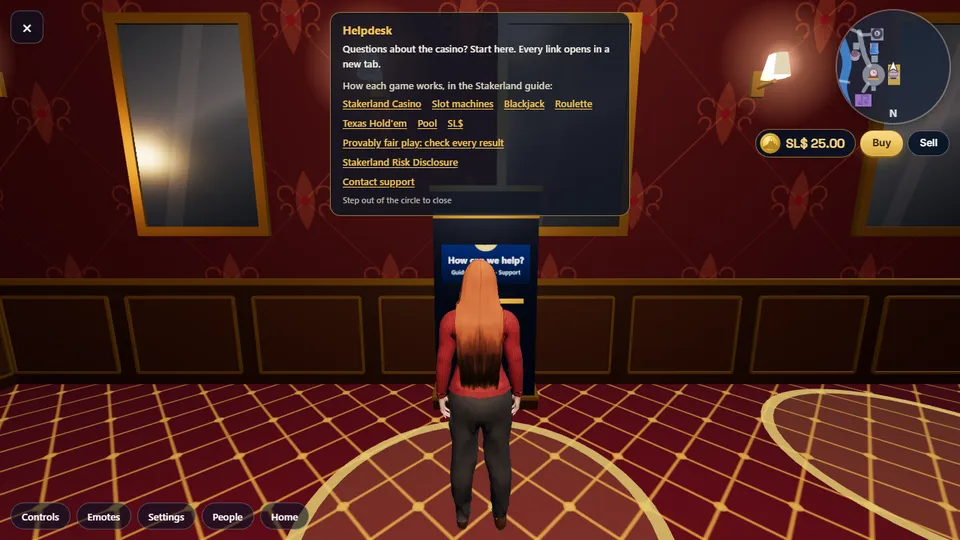
The Helpdesk kiosk stands against the left wall, between the slot machines and the blackjack tables. Step into the gold circle in front of it for its card, which links each game's section of this guide, SL$ and how provably fair play works, the Stakerland Risk Disclosure, and Contact support. Every link opens in a new tab.
Slot machines
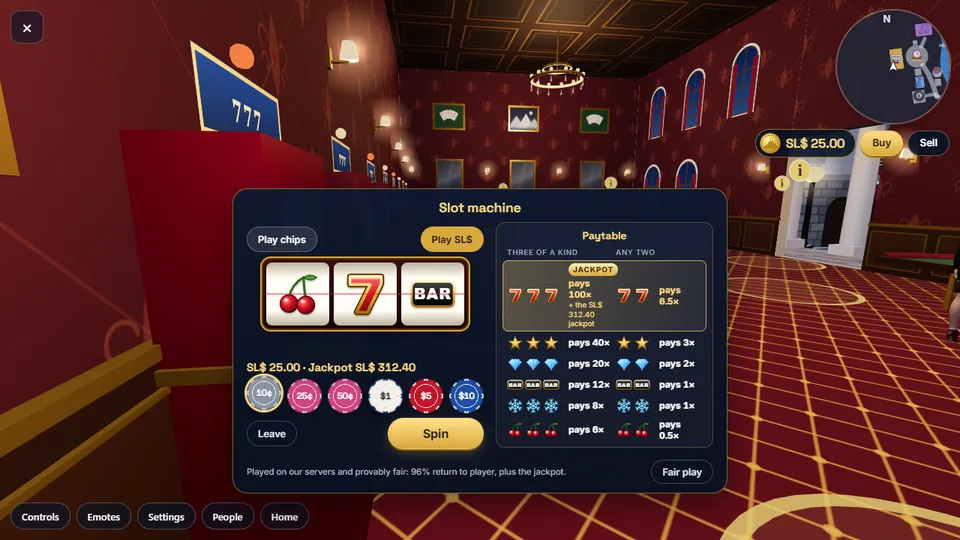
Sit on the stool at a machine to play. Pick a bet of 10, 25, 50 or 100 chips, then press Spin or Space. Press Leave (or Esc) to get up.
For SL$ the bets are SL$0.10, SL$0.25, SL$0.50, SL$1, SL$5, SL$10, SL$25 or SL$50.
Each machine has three reels and one line. Every reel has 21 stops, and the six symbols take different numbers of them. From the rarest to the most common, they are a red 7, a gold star, a blue diamond, a black BAR plate, an icy snowflake and a pair of cherries. The table shows each symbol's stops on one reel.
Three of a kind on the line pays the three-of-a-kind multiple of your bet. Otherwise, any two of the three reels showing the same symbol pays its two-of-a-kind multiple. The bet is taken on each spin, and a win pays its multiple of the bet in whole chips, rounded down.
The paytable beside the reels (under them on a phone) shows the same pays with the pictures: each symbol three times with what three of a kind pays, then twice, under Any two, with what two of a kind pays. Three red 7s are the top row, marked Top prize with play chips, or Jackpot, with the jackpot's amount, when you play for SL$. A bet of SL$10 or more wins all of the jackpot; below that the row shows the share of it your bet wins, such as 10% at SL$1.
When a spin wins, the reels that made the line glow and its row in the paytable lights up. Three red 7s also bring a gold flash and a shower of coins.
Over a very long run this paytable pays back about 96.1% of what is bet. Every spin is independent: the reels have no memory, and no machine is due to pay. There is no jackpot with play chips.
| Symbol | Stops on each reel | Three of a kind | Two of a kind |
|---|---|---|---|
| Red 7 | 1 of 21 | 100x | 6.5x |
| Gold star | 2 of 21 | 40x | 3x |
| Blue diamond | 3 of 21 | 20x | 2x |
| BAR | 4 of 21 | 12x | 1x (your bet back) |
| Snowflake | 5 of 21 | 8x | 1x (your bet back) |
| Cherries | 6 of 21 | 6x | 0.5x (half your bet back) |
Blackjack
Sit on a stool at either blackjack table and pick a bet of 10, 25, 50 or 100 chips, then Deal. You play against the dealer, not the other players: the aim is a hand closer to 21 than the dealer's without going over.
For SL$ the chips are SL$0.10, SL$0.50, SL$1, SL$5, SL$10, SL$50, SL$100, SL$250 or SL$500.
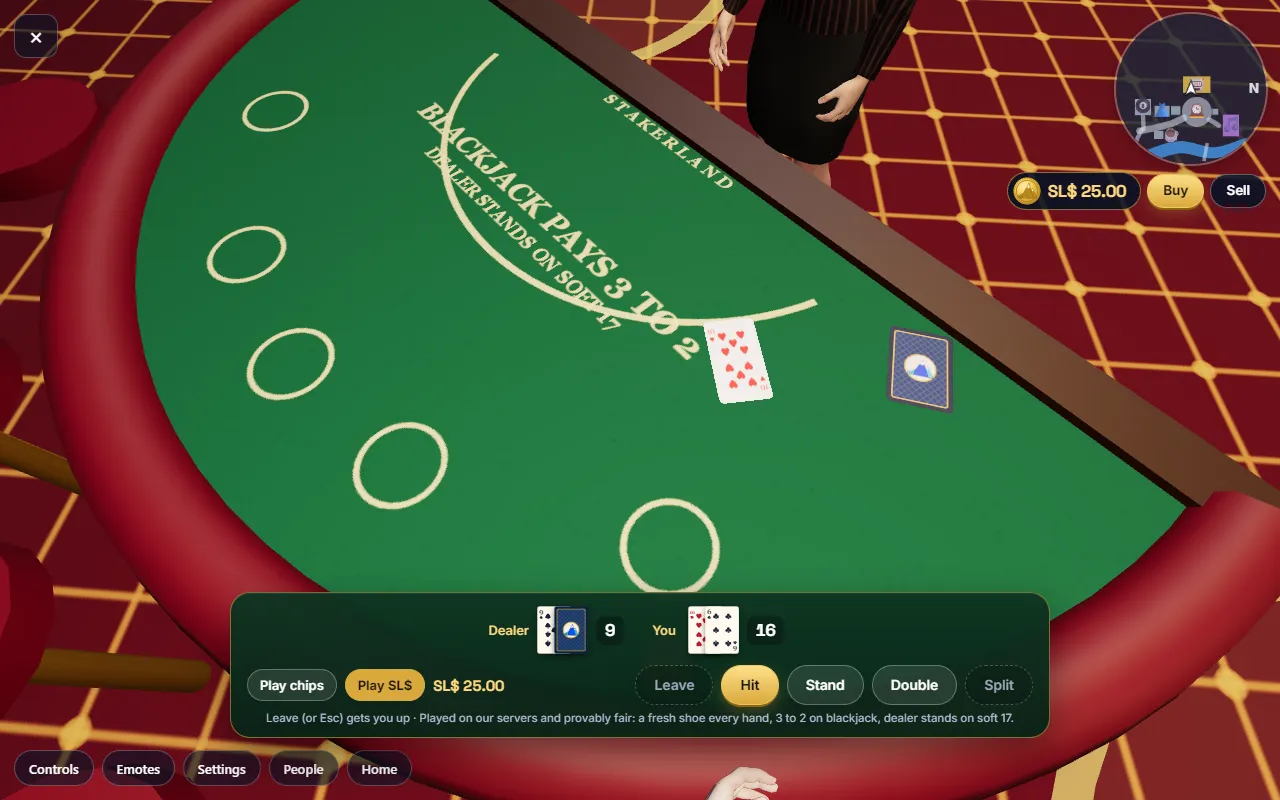
While you sit, the view looks down on the table and the cards are dealt onto the felt in front of you. A bar along the bottom of the screen shows both hands and their totals (the dealer's counts only the face-up card until the hidden one is turned), the chips to bet with and your moves. A banner calls each round: a win, a push or the dealer's.
Cards 2 to 10 count their number, jacks, queens and kings count 10, and an ace counts 11 or 1, whichever is better for the hand. A hand with an ace counting 11 is soft.
The shoe is six decks, shuffled with a cryptographic random number, and reshuffled before a round once fewer than a quarter of its cards are left. You and the dealer get two cards each; one of the dealer's is face down.
Blackjack is an ace and a ten-value card as your first two cards. It pays 3 to 2 (rounded down to whole chips) at once. The dealer checks for blackjack under an ace or a ten: if the dealer has one, the round ends there and you lose, unless you have blackjack too, which is a push.
On your turn: Hit takes a card; Stand keeps your total; Double doubles your bet for exactly one more card, on any first two cards; Split turns two cards of the same value (two eights, or a king and a queen) into two hands with a bet each. You can split once a round, and double after splitting. Split aces get one card each, and 21 after a split counts as 21, not blackjack.
There is no insurance, no even money and no surrender. Once your hands are done, the dealer turns the hidden card and draws to 16, standing on every 17, soft 17 included. If every hand of yours went over 21, the dealer does not draw. Leaving mid-round (with Leave or Esc) stands every hand still open, and the round settles as usual.
| Result | What you get |
|---|---|
| Blackjack | Your bet back plus 1.5 times it (3 to 2) |
| Win (closer to 21, or the dealer goes over) | Your bet back plus the same again (1 to 1) |
| Push (the same total as the dealer) | Your bet back |
| Lose, or go over 21 (bust) | Nothing: the bet is lost |
Roulette
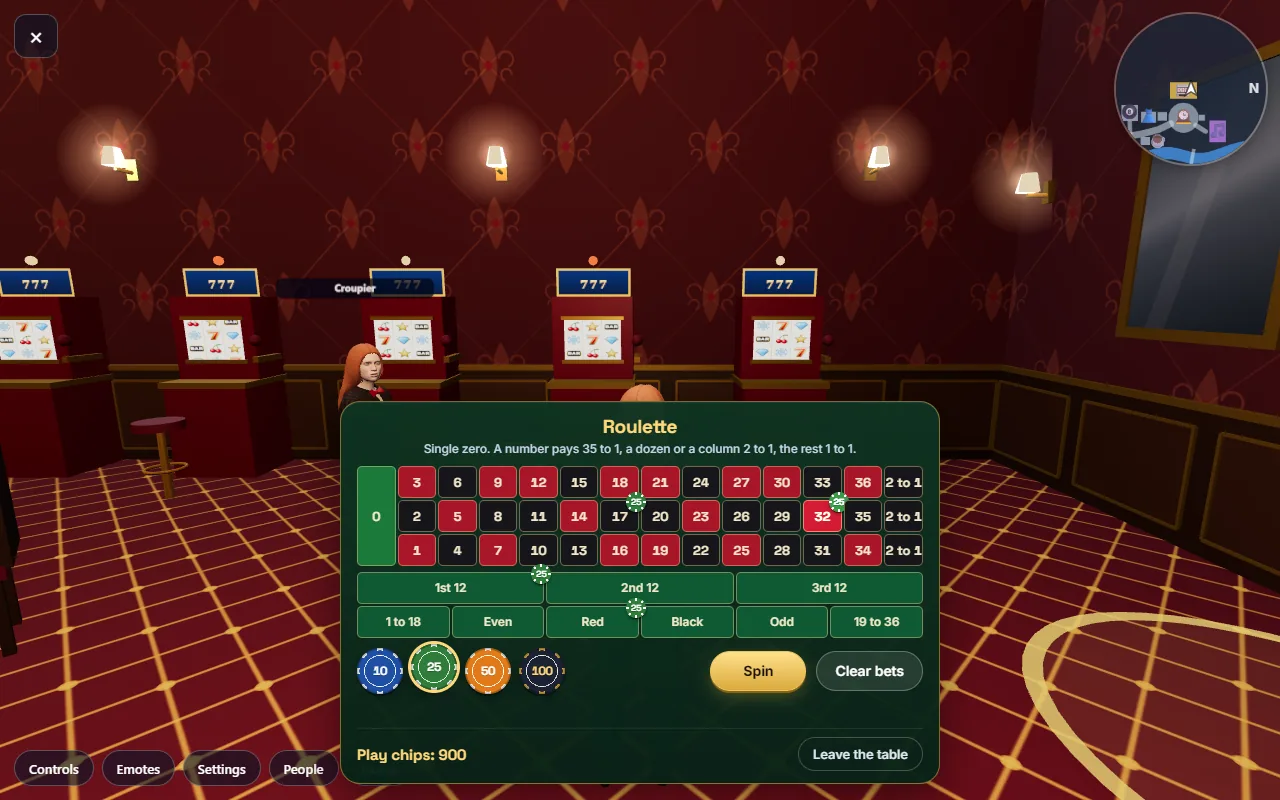
Stakerland roulette is European: one zero and the numbers 1 to 36, 37 pockets in all. Click the table, or the croupier and then Place a bet, to open the board. Pick a chip of 10, 25, 50 or 100, and click the spots you want to bet on. Clicking a spot again adds another chip.
For SL$ the chips are SL$0.10, SL$0.50, SL$1, SL$5, SL$10, SL$50 or SL$100.
There is one wheel, shared by everyone in your copy of the town. The first chip anyone puts down opens the betting for 15 seconds, and a clock beside the board's title counts them down, ticking through the last three. Then no more bets are taken, the ball goes round for about 5 seconds, and the number stays up for 4 more before the board says Place your bets again.
You can have up to 5,000 chips down on one spin. Clear bets takes your chips back while the betting is open. If you close the board or leave before the spin, your chips come back; once the ball is rolling, your bets stay and settle when it stops.
The room picks each pocket with a cryptographic random number, each of the 37 equally likely, and everyone at the table sees the same spin. The last numbers are shown on the board. When the ball lands on 0, every bet loses except a straight bet on 0 itself.
When you have chips on a spin, the view goes to the wheel as the betting closes, so you can watch the ball up close, and comes back 1.5 seconds after it stops. Esc or Back to the board ends it sooner.
When the ball stops, a banner names the number, with what came back if you had chips on the spin, and the board lights the winning number and every bet it paid for a few seconds.
| Bet | Wins when the ball lands on | Pays |
|---|---|---|
| A number (straight) | That number, 0 included | 35 to 1 |
| Dozen | 1 to 12, 13 to 24 or 25 to 36 | 2 to 1 |
| Column | One of the board's three columns of 12 numbers | 2 to 1 |
| Red or black | A number of that colour | 1 to 1 |
| Odd or even | An odd or an even number (not 0) | 1 to 1 |
| 1 to 18 or 19 to 36 | A number in that half | 1 to 1 |
Dice, Plinko, Mines and Crash
Dice, Plinko, Mines and Crash are the casino's quick games, the kind the crypto casinos build in house. Each returns 99% to players over a long run (a 1% house edge), and each plays with play chips or SL$. Dice, Plinko and Mines are on the casino web page only. Crash is on the web page and on a big screen in the 3D casino, and both show the same round.
They share one set of controls. Type your bet, or use ½ and 2x to halve or double it, and Max for the most the game can take right now. Manual plays one bet at a time. Auto plays a number of bets for you (0 keeps going until you stop it): after a win or a loss it can go back to your first bet or raise it by a percentage, and it stops once your profit or your loss reaches the amount you set.
Dice, Plinko and Mines have Instant bet, which skips the animation. Hotkeys are off until you turn them on: Space bets, A halves the bet, S doubles it, D sets it to zero, and Esc leaves the game. Each game's Rules panel lists its own keys.
Under each game are My bets (your latest bets and what they paid), Live stats (your profit, wagered, wins and losses since you opened the game), Fairness (your seeds, and a checker that recomputes any past result in your browser) and Rules. SL$ bets are SL$0.10 to SL$1,000, and each game pays its wins from its own prize pool.
Dice
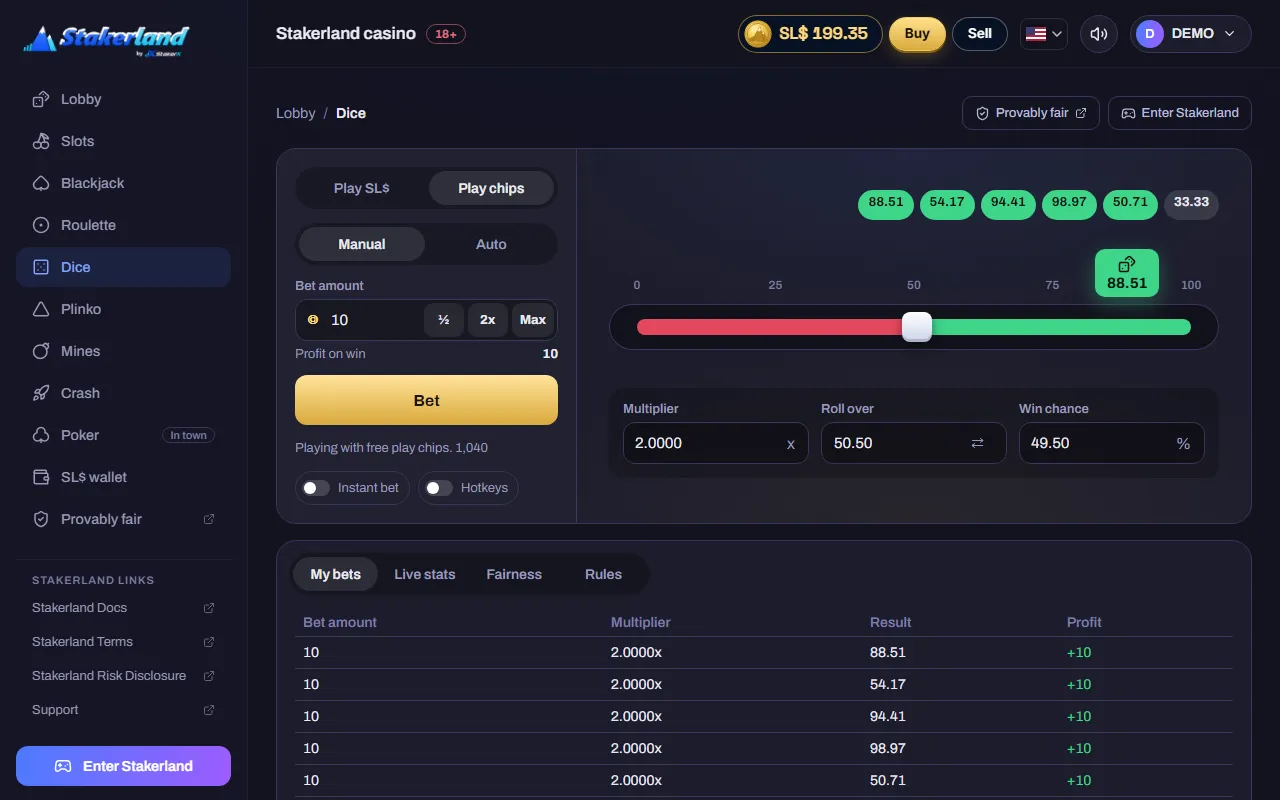
Each roll is a number from 0.00 to 99.99. Pick a target and roll over or under it: over wins on the target or higher, under wins below it. The win chance can be 0.01% to 98%. The multiplier is 99 divided by the win chance, rounded down to four decimals, so Dice returns 99% to players (a 1% house edge). SL$ bets are SL$0.10 to SL$1,000, and one bet can win at most a tenth of Dice's prize pool.
Drag the slider, or type the target, the win chance or the multiplier: the other two follow. One click on Roll over switches to Roll under and back. The result is instant.
Plinko
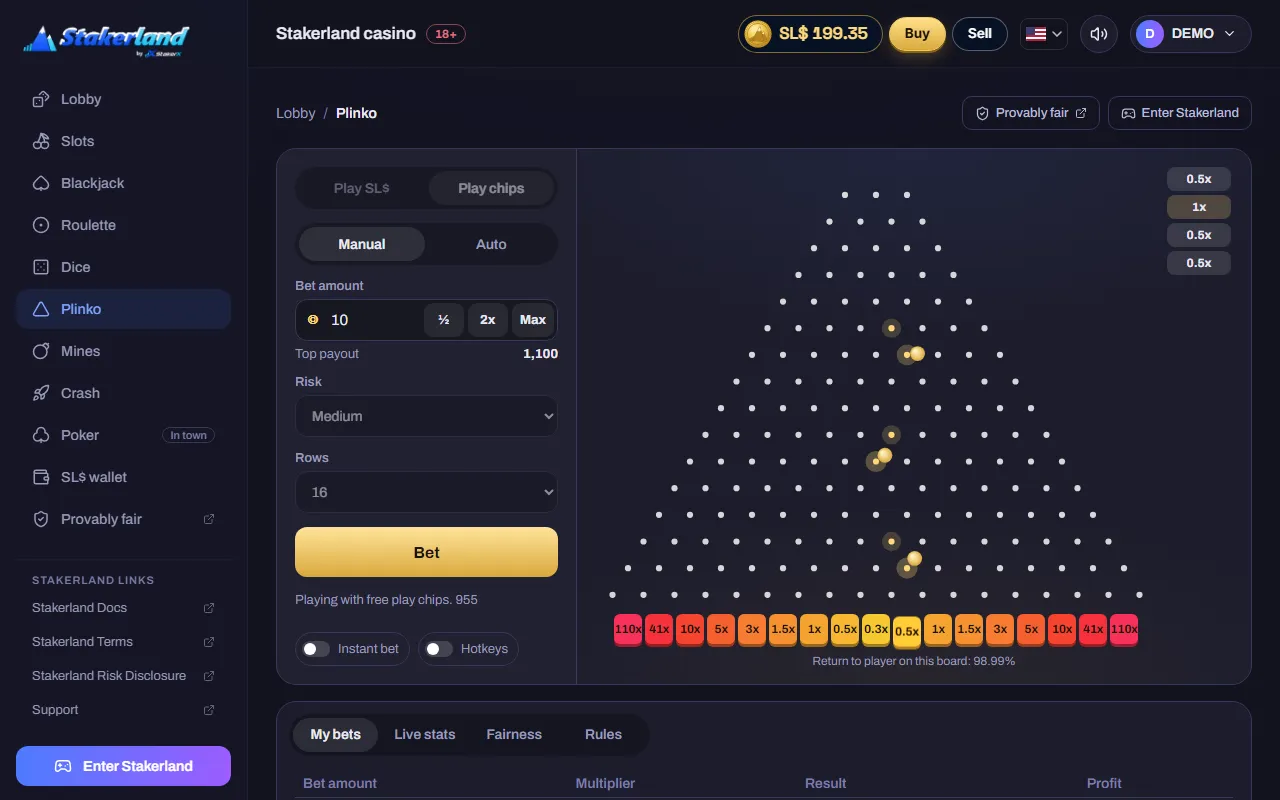
Drop a ball through the pegs. At every row it goes left or right with an equal chance, and the slot it lands in sets the payout: the outer slots pay the most and are the hardest to reach. Choose 8 to 16 rows and a low, medium or high risk; each pair has its own fixed payouts. Every board returns 98.96% to 99% to players (a house edge of at least 1%), shown under the board. SL$ bets are SL$0.10 to SL$1,000 a ball, and one ball can win at most a tenth of Plinko's prize pool, counted on the board's top payout.
Press Bet again while balls are falling to drop more at once. Rows and risk unlock once every ball has landed. Point at a slot to see its chance and its profit. A ball that lands on 1x gives your bet back.
Mines
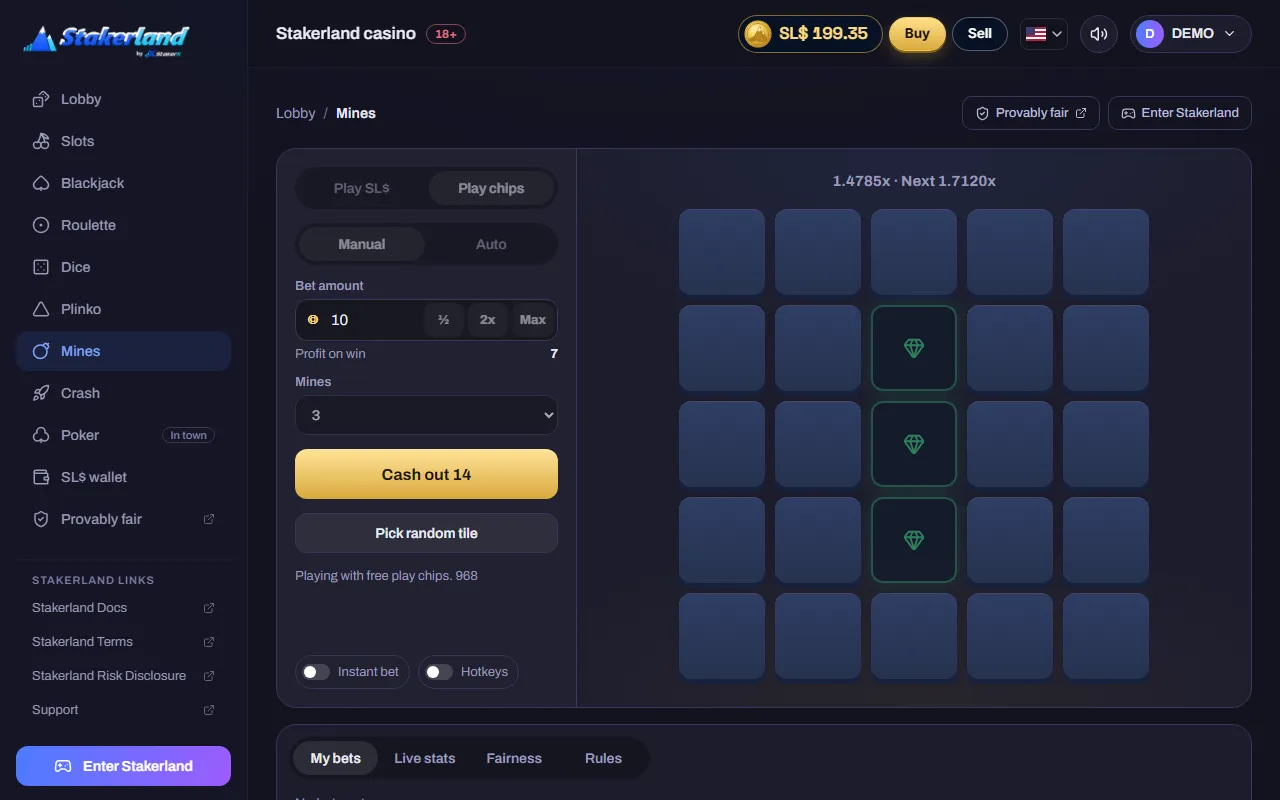
A board of 25 tiles hides 1 to 24 mines, chosen before the round. Pick tiles one at a time: each gem raises the multiplier, and a mine ends the round lost. Cash out after any gem. The multiplier is 0.99 divided by the chance of every pick so far being a gem, rounded down to four decimals, so Mines returns 99% to players, up to the max win (a 1% house edge). SL$ rounds are SL$0.10 to SL$1,000, and one round can win at most a tenth of Mines' prize pool, fixed when it starts. A round left open is settled for you 10 minutes after your last pick, and at most an hour after it starts.
Pick random tile picks one for you, and the board shows the next pick's multiplier. When the round ends, every tile turns over. For Auto, first mark the tiles to pick on the board: each round picks those tiles and cashes out after the last, unless one of them is a mine.
If you leave in the middle of a round, it stays open, and picks up where you left it when you come back.
Crash
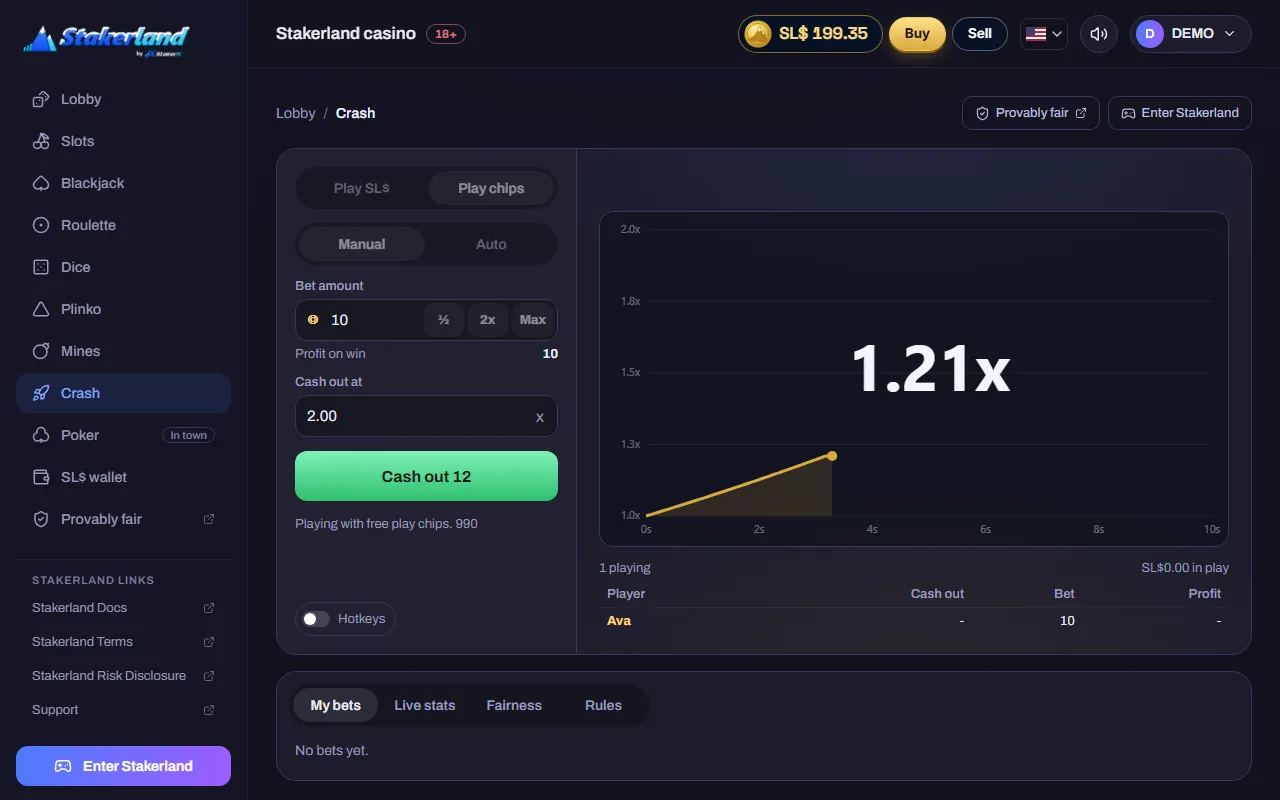
Each round, a multiplier climbs from 1.00x until it crashes. Bet in the 6 seconds before it starts, then cash out before the crash: by hand, or at a Cash out at target set before the round. A hand cash-out pays only below the crash point; a target pays at or below it. About 2 rounds in 100 crash at 1.00x and pay nobody. Whatever you do, Crash returns 99% to players (a 1% house edge). SL$ bets are SL$0.10 to SL$1,000, one a round. A bet wins at most SL$1,000 above its stake and at most 1,000x, and when a round's winnings reach a tenth of Crash's prize pool, everyone still in is cashed out there.
Press Bet (next round) while a round is running to join the next one, and Cancel takes your bet back before it starts. Auto bet needs a Cash out at target. The board lists everyone's bets this round, and a strip shows the latest crash points.
In the 3D casino, Crash is the big screen on the right wall. Click the stand under it to play, with the same panel as on the casino web page.
Texas Hold'em poker
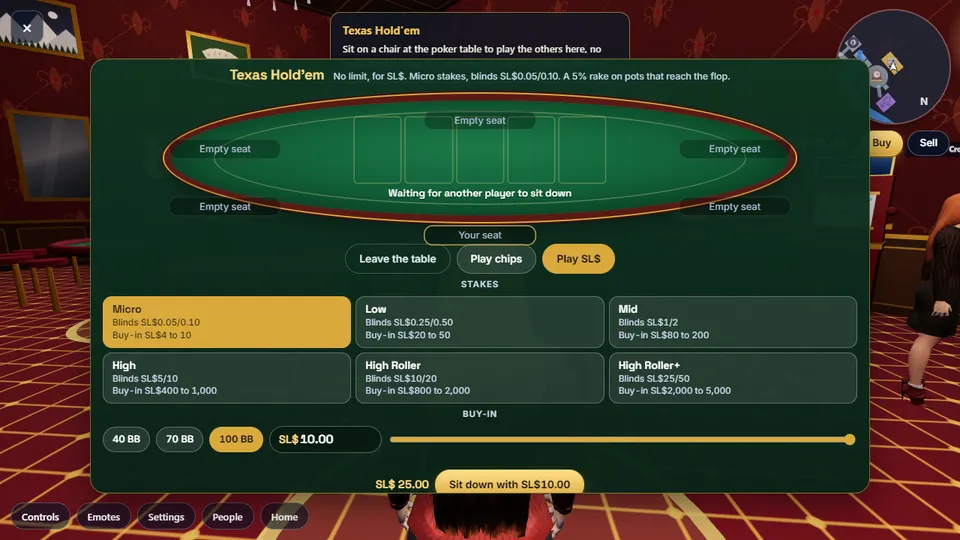
The poker table seats six and plays no-limit Texas Hold'em between players, not against the house. With play chips the blinds are 5 and 10. Sit on a free chair and buy in for 200, 500 or 1,000 of your play chips; whatever is in front of you when you get up goes back to your chips.
The first player to sit at an empty table chooses what it plays for: play chips or SL$, and for SL$ the stakes, from Micro to High Roller+ (see SL$ poker stakes below). Everyone who sits plays the same until the table is empty again. At an SL$ table you buy in for any amount from 40 to 100 big blinds: set it with the slider, with the 40, 70 and 100 big blind buttons, or by typing it.
If you get up from an SL$ table and sit back down at the same stakes within 30 minutes, you buy in for at least what you left with, up to that table's largest buy-in. There is no topping up at your seat: to add chips, get up and buy in again.
A hand is dealt once two or more seated players have chips. If you sit down during a hand, you are dealt in from the next one. The dealer button moves one seat each hand; the two players after it post the small and big blinds. Heads up, the button posts the small blind and acts first before the flop.
Everyone gets two cards face down. Betting goes round the table before the flop, after the flop (three cards in the middle), after the turn (a fourth) and after the river (a fifth). On your turn you can fold, check when there is nothing to call, call, raise, or go all in.
The panel draws the table as an oval: your seat at the bottom and the others round it in the order they sit, each with its name, chips and cards, its bet pushed out toward the middle, and the dealer (D), small blind (SB) and big blind (BB) buttons beside it. The board and the pot are in the middle, and the seat whose turn it is lights up, with its clock.
The panel shows the pot, the five cards in the middle, your two cards with what they make, and every seat's chips and bet. To raise, set the amount with the slider and press Raise to (Bet when nobody has bet yet): the amount is your whole bet for this round. The buttons by the slider set it for you: 2.5, 3 or 4 big blinds before the flop when nobody has raised, otherwise half the pot, three quarters of it or the whole pot. You still press Raise to.
A raise is at least the size of the last full raise, and at least the big blind; the most you can bet is everything in front of you. An all-in that is short of a full raise does not let players who have already acted raise again.
You have 15 seconds to act, then your time bank: 15 seconds to start, 5 more every 10 hands you are dealt, up to 60. Only the time you take past the first 15 seconds comes off the bank. If both run out, you check if you can or fold if you cannot, your bank goes to 0, and you sit out.
To take a break without leaving, press Sit out (or type /sitout). You keep your seat and your chips, and you are not dealt in until you press Sit in (or type /sitin), from the next hand. Sitting out in the middle of a hand does not fold it. A seat that stays sat out for 7 minutes is stood up between hands, with your chips back.
If hands were dealt while you sat out, the first hand after you sit in costs you the blinds you missed: a big blind, which counts toward your call, and a dead small blind, which goes straight into the pot. You owe nothing extra if that hand puts you in the blinds anyway. There is no waiting for the big blind, and a player who has just sat down owes nothing.
Leave the table gets you up at any time; during a hand you fold, and chips you already put in stay in the pot. At a play-chip table, leaving the town or losing your connection gets you up the same way. At an SL$ table your seat is kept and sat out, with 30 seconds more when your turn comes: come back and press Sit in, or after 7 minutes the seat is stood up with your SL$ back. A player who runs out of chips is stood up after the hand.
When the betting ends with two or more players still in, everyone still in shows their cards, and the best five-card hand from your two cards and the five in the middle wins. If everyone else folds, the last player wins without showing. When players are all in and no more betting can happen, the rest of the board is dealt straight out.
When someone is all in for less than others bet, the chips above their stake form a side pot, which only the players who put into it can win. Each pot goes to its best hand; a tie splits it evenly, with an odd chip to the first winner after the button. The next hand is dealt 6 seconds after a hand ends. There is no rake with play chips; the SL$ rake is under Published returns.
| Hand | What it is |
|---|---|
| Straight flush | Five cards in a row, all one suit |
| Four of a kind | Four cards of one rank |
| Full house | Three of one rank and two of another |
| Flush | Five cards of one suit |
| Straight | Five cards in a row; A-2-3-4-5 is the lowest, 10-J-Q-K-A the highest |
| Three of a kind | Three cards of one rank |
| Two pair | Two cards of one rank and two of another |
| A pair | Two cards of one rank |
| High card | None of the above; the highest cards decide |
SL$ poker stakes
An SL$ poker table plays one of six stakes, chosen by its first player. The blinds and the buy-in rise together: at every level you buy in for 40 to 100 big blinds, and the rake's cap is counted in that table's big blinds.
| Stakes | Blinds | Buy-in |
|---|---|---|
| Micro | SL$0.05/SL$0.10 | SL$4 to SL$10 |
| Low | SL$0.25/SL$0.50 | SL$20 to SL$50 |
| Mid | SL$1/SL$2 | SL$80 to SL$200 |
| High | SL$5/SL$10 | SL$400 to SL$1,000 |
| High Roller | SL$10/SL$20 | SL$800 to SL$2,000 |
| High Roller+ | SL$25/SL$50 | SL$2,000 to SL$5,000 |
Poker from the chat
Everything at the poker table can also be typed in the chat (T). /jointable needs you to be standing by the table, and the other table commands work once you are seated. /pokerhelp lists them anywhere.
| Command | What it does |
|---|---|
| /jointable amount | Sits you on the first free chair with that buy-in in play chips (200, 500 or 1,000). Without an amount it takes the smallest. |
| /jointable sld amount | The same with an SL$ buy-in, named in SL$ (such as /jointable sld 7): any amount from 40 to 100 big blinds at the stakes the table plays, or the ones picked on the panel. Without an amount it takes the smallest. |
| /leavetable | Gets you up, as Leave the table does. |
| /sitout and /sitin | Sit out from the next hand, and sit back in. |
| /call, /check, /fold, /allin | Your move, on your turn. A move that is not allowed then, such as /check when there is a bet to call, is ignored. |
| /raise amount or /bet amount | Raises or bets to that total for this round, such as /raise 60. At an SL$ table the amount is in SL$, such as /raise 1.50. |
| /pokerhelp | Shows these commands. |
Pool and pool betting
The arcade has two eight-ball pool tables. Click one to play: practise alone, or take a seat and wait for someone to play you. The room referees every shot, so both players and everyone watching see the same table.
The first player to sit chooses the stake: a friendly game for nothing, or 10, 50, 100, 250 or 500 play chips. The next player to join plays for that stake. Both stakes go on the table as the game begins, and the winner takes both.
A pool bet can also be for SL$1, SL$5, SL$10, SL$25 or SL$100 each. Both stakes are taken from the two players' SL$ when the second one sits, and only then does the game start. The winner takes the pot less an 8% house cut: SL$184 from a game of SL$100 each.
To shoot on a computer, click to take the mouse on your turn, move it to turn the cue (hold Shift to aim finely) and scroll to bring the view nearer or further. Hold the left button and the power rises and falls; let go to shoot. On a phone, drag to turn the cue, set the power with the slider, then press Shoot. After a shot the view switches straight to looking down on the whole table while the balls roll, then goes back by itself. Meanwhile, move the mouse to look round and scroll to bring the view nearer or further; on a phone, drag to move over the table and pinch to zoom.
The first player breaks from the head spot. The table is open until someone pots a ball on a fair shot: that ball's group, solids (1 to 7) or stripes (9 to 15), becomes theirs, and the other group the opponent's.
Once the groups are set, the panel shows each player's group as a ball, solid or striped, beside their name with how many of their balls are left, and outlines the player to shoot.
Pot a ball of your own group on a fair shot and you shoot again; anything else passes the turn. Once your group is cleared, you shoot at the 8. Shots are not called.
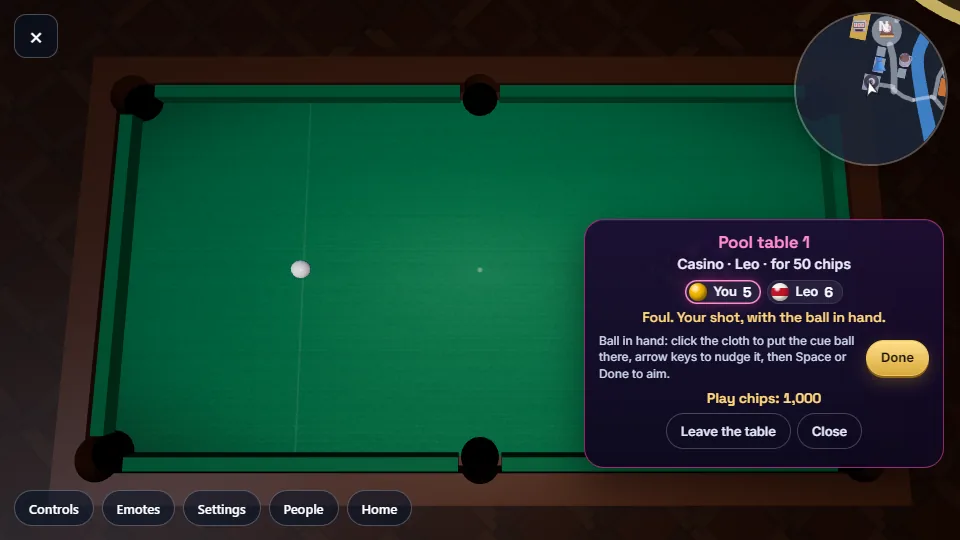
A foul is potting the cue ball (a scratch), hitting no ball, or hitting a ball that is not yours first: the 8 before your group is cleared, the other group's ball, or anything but the 8 once your group is cleared. After a foul your opponent has the ball in hand and can put the cue ball anywhere clear on the cloth before shooting.
With the ball in hand, the view looks straight down on the table. Click the cloth to put the cue ball there (it shows red where it cannot go), nudge it with the arrow keys, then press Space or Done to aim. On a phone, tap the cloth, then Done.
Pot the 8 on a fair shot after clearing your group and you win. Pot it any other way (before your group is cleared, or on a foul) and you lose.
With play chips each shot has a 75-second clock. If it runs out, the turn passes to your opponent, without ball in hand. In an SL$ game the clock is 30 seconds, running out is a foul that gives your opponent the ball in hand, and a third time out in a game loses it.
Leaving the table mid-game forfeits the game, and your opponent wins the stakes. Leaving the town or losing your connection does the same in a play-chip game. In an SL$ game your seat is held for a minute with the clock stopped, and you lose only if you are not back by then. A practice game has no clock and simply ends when you leave.
The arcade also has a claw machine, Snow Grab, for play chips only. Click it to play: each try costs 25 play chips. Steer the claw with the arrow keys or WASD (on a phone, the arrow buttons) within 15 seconds, then press Drop or Space. If the claw comes down on a plush, it holds it 1 time in 6, or 1 time in 4 when it lands dead centre. A plush won drops into the tray with 50 play chips.
Info markers
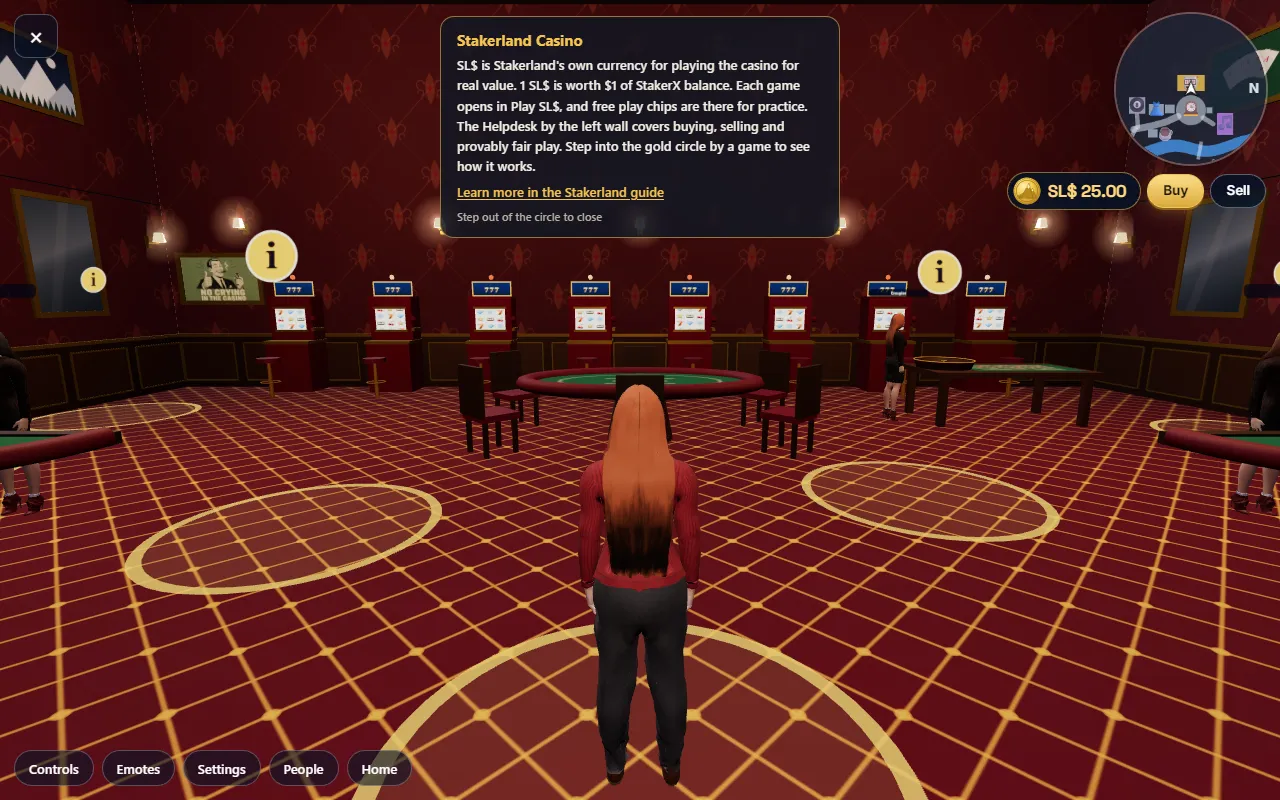
A gold circle on the ground with an "i" over it explains the place it stands in. Step into one to see its card, and step out to close it.
You will find them inside the casino (one by the door, one by each game and one at the Helpdesk), in the arcade, at the skate park, the ice rink, the snowmobiles, the clothing store, the basketball court and the volleyball court. Each card links back to this guide.
SL$, the Stakerland Dollar
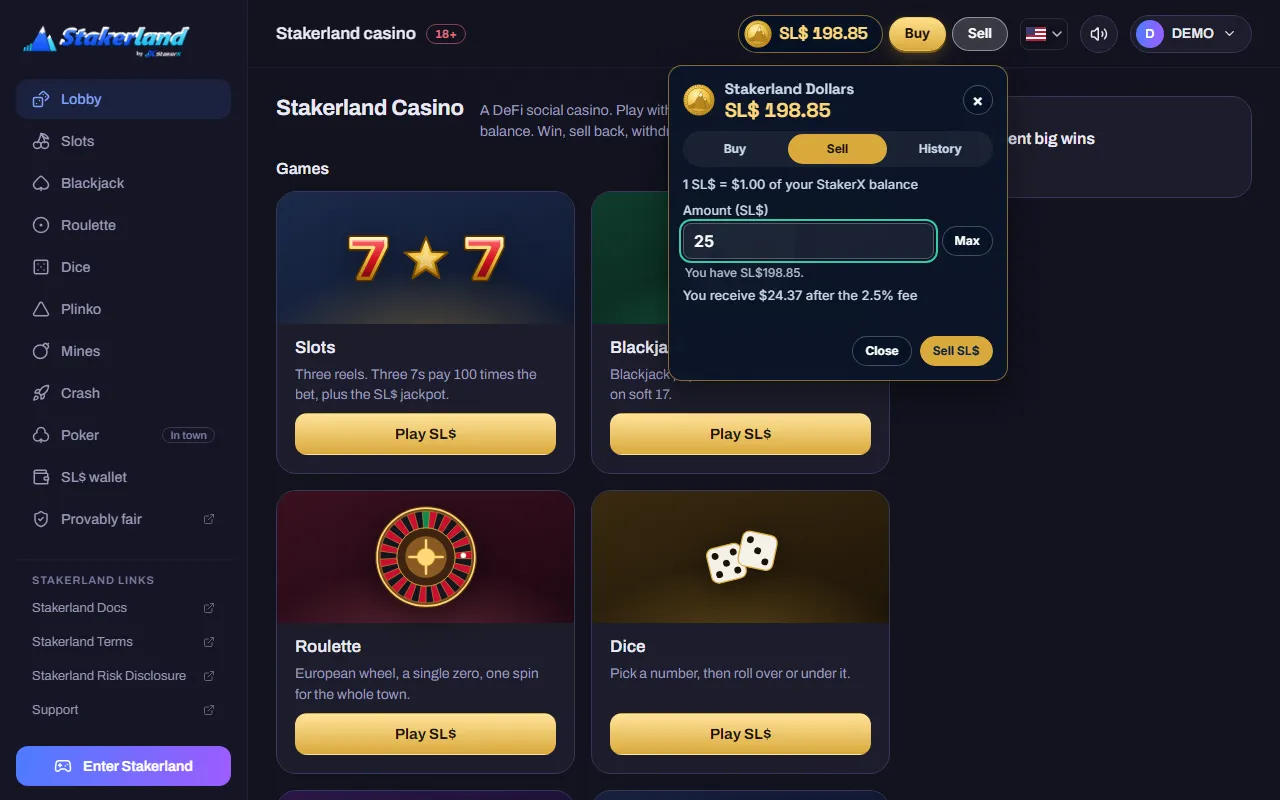
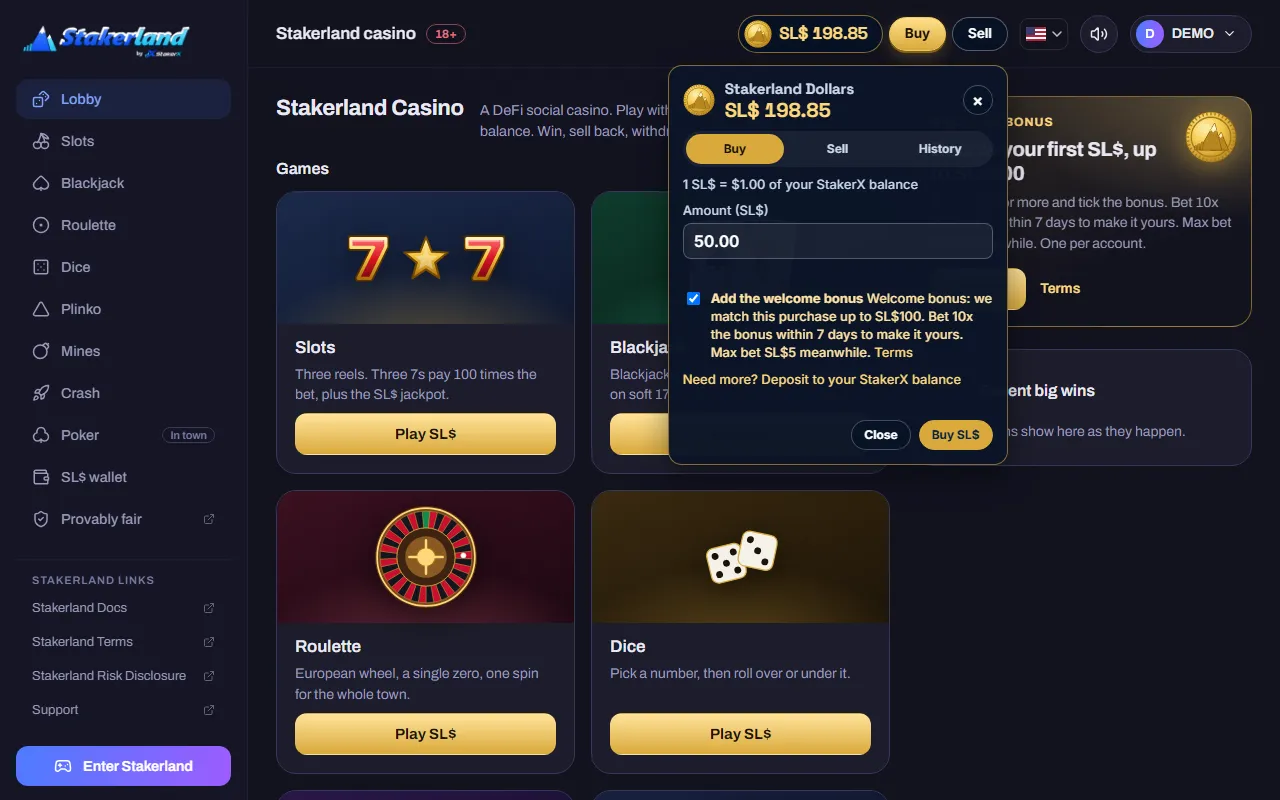
SL$ is Stakerland's own currency for playing the casino for real value. 1 SL$ is worth $1 of StakerX balance, and amounts show with two decimals. Your SL$ balance shows at the top right of the screen, by the map, beside a gold coin, with a gold Buy button and a Sell button. It counts up when a game pays you, with what came in shown in green, and down as you bet. Clicking it opens your wallet, with Buy, Sell and History tabs.
SL$ is not an investment and earns nothing while you hold it. It cannot be sent to other players. The free play chips stay for practice.
Buying and selling SL$
Buying: SL$ is bought 1 to 1 with your available StakerX balance, the part you could withdraw right now. Locked principal, locked yield, bonus balance and anything set aside for a pending withdrawal cannot buy SL$. Your first purchase asks you to accept the Stakerland Risk Disclosure.
Selling back: SL$ you sell goes back into your StakerX balance, less a 2.5% fee. From there you withdraw it as USDC on Solana like any other balance.
In the wallet's Buy and Sell tabs, type an amount such as 10 or 12.50: commas are added as you type, and the cents when you leave the box. When selling, Max fills in your whole SL$ balance, and the wallet shows what you will receive after the fee. When buying, the Deposit to your StakerX balance link opens the StakerX deposit page in a new tab.
A sale can sometimes wait for approval before it is paid: your balance then shows the amount waiting, and the result comes to your chat. When SL$ trading is paused for a moment, the wallet says so, and you can buy or sell again once it resumes.
Purchases come back first. Whatever you sell is counted, first, as returning what you bought and have not yet sold back. That part is ordinary balance, under the same withdrawal limits it had before you bought SL$.
Only what you sell beyond your purchases counts as net casino winnings. The Fair Withdrawal Policy and the daily platform allowance do not apply to winnings, and Lean Mode's daily queue does not apply to your net casino winnings: they are paid out when you withdraw them. Only the review of large withdrawals still applies. Spending counts against winnings first: a stake, more SL$ or a withdrawal uses them up before anything else, so the casino cannot carry other money around the policy.
The welcome bonus
While the offer is on, one SL$ purchase of SL$10 or more can come with a welcome bonus: tick Add the welcome bonus in your wallet's Buy tab before you buy. We match the purchase one to one, up to SL$100 of bonus SL$, once per StakerX account, from 7 days after your first StakerX deposit (until then the tick does not show). It is optional: buy without the tick and the offer stays open for a later purchase.
You can add it only when nothing of yours is still in play, such as an unfinished hand or round, SL$ at a poker table or in a pool bet, or a sale waiting for approval. If the offer's budget cannot cover your bonus, your purchase still goes through without it, and the wallet says so.
To make the bonus yours, bet 10 times your purchase plus the bonus within 7 days: SL$100 bought with SL$100 of bonus needs SL$2,000 of bets. A bet counts when it settles, by game: Slots 100% · Blackjack and roulette 10% · Dice, Plinko, Mines, Crash, poker and pool betting excluded. A bonus given before these rules came in keeps the rules it was given under. Meanwhile each bet can be at most SL$5 (in Plinko, each ball), and SL$ poker seats and pool betting are closed to you.
Your wallet shows the bonus, how much you have wagered of what is needed, and the days left. Once you reach it and nothing of yours is still open, the bonus is cleared: the limits lift and it is ordinary SL$, yours to play or sell.
Selling SL$, Cancel bonus in your wallet, or the 7 days running out first ends the bonus without clearing it. You then keep at most your cash in: the SL$ you held before that purchase, the purchase itself, and anything you bought since. Anything above it goes back to the house. Before you sell or cancel, the wallet tells you how much you would keep. Section 19 of the Stakerland Terms has the full rules.
Referrals: earn SL$ for life
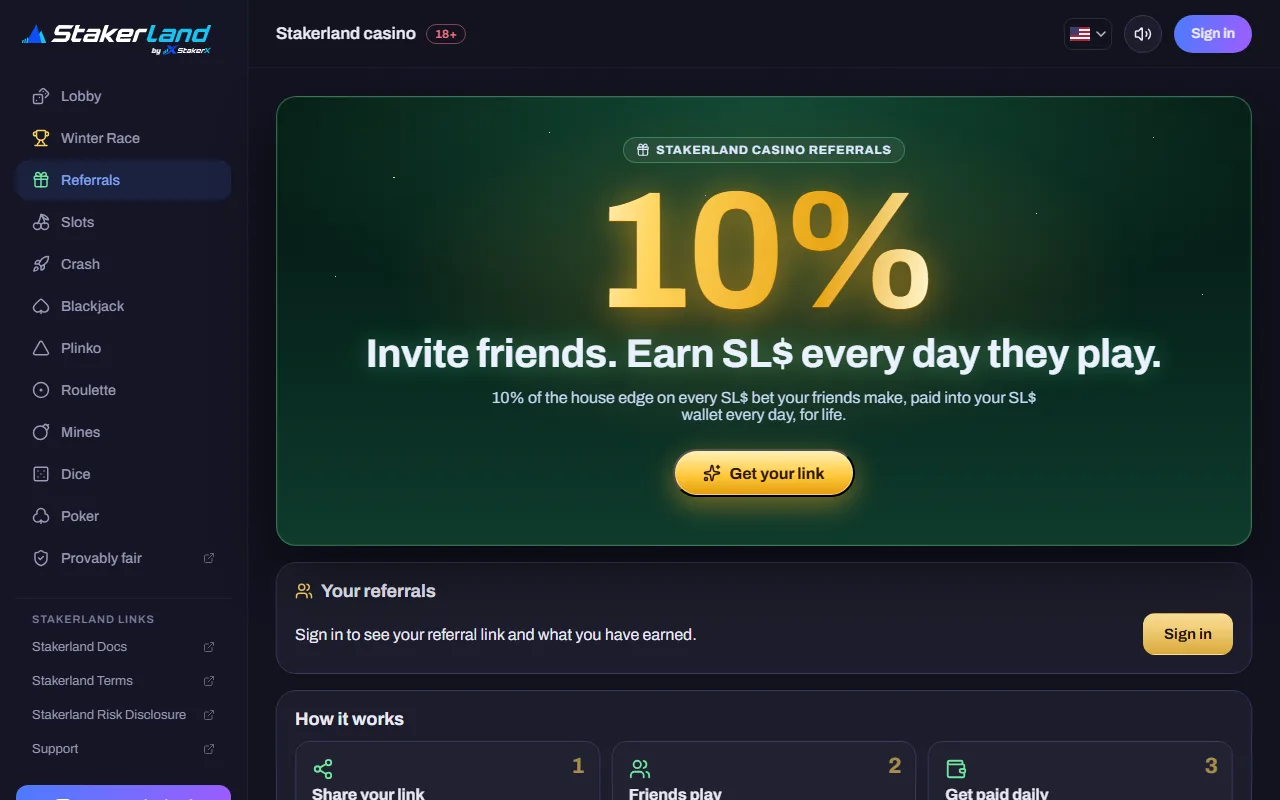
Invite friends to StakerX and earn SL$ every day they play the casino, for as long as they play. Your casino link carries your StakerX referral code and takes friends straight to the casino, so there is nothing new to set up. Referrals in the casino's side menu shows your link with Copy and share buttons, how many people you referred and what you have earned.
You earn 10% of the house edge on every settled SL$ bet the people you invited make in the casino's house games. The house edge is each game's published edge, not what they won or lost, so you earn the same either way. A friend who bets SL$1,000 on slots earns you SL$3.94.
Each day's earnings (UTC) are paid into your SL$ wallet the next day, rounded down to the cent, and anything smaller carries to the next day. The house pays them from its own SL$: nothing is ever taken from your friends.
Only bets made with your friends' own SL$ count: bonus funds, play chips, poker and pool betting do not. It is one level only: you earn on the people you invited, not on the people they invite.
Nothing is paid for a friend who has never made a StakerX deposit, for accounts that share a funding source, a withdrawal address or a device, or for a referral that is held or under review. Section 21 of the Stakerland Terms has the full rules.
| Game | You earn |
|---|---|
| Slots | SL$0.39 |
| Roulette | SL$0.27 |
| Crash, Dice, Mines and Plinko | SL$0.10 |
| Blackjack | SL$0.05 |
Your SL$ history
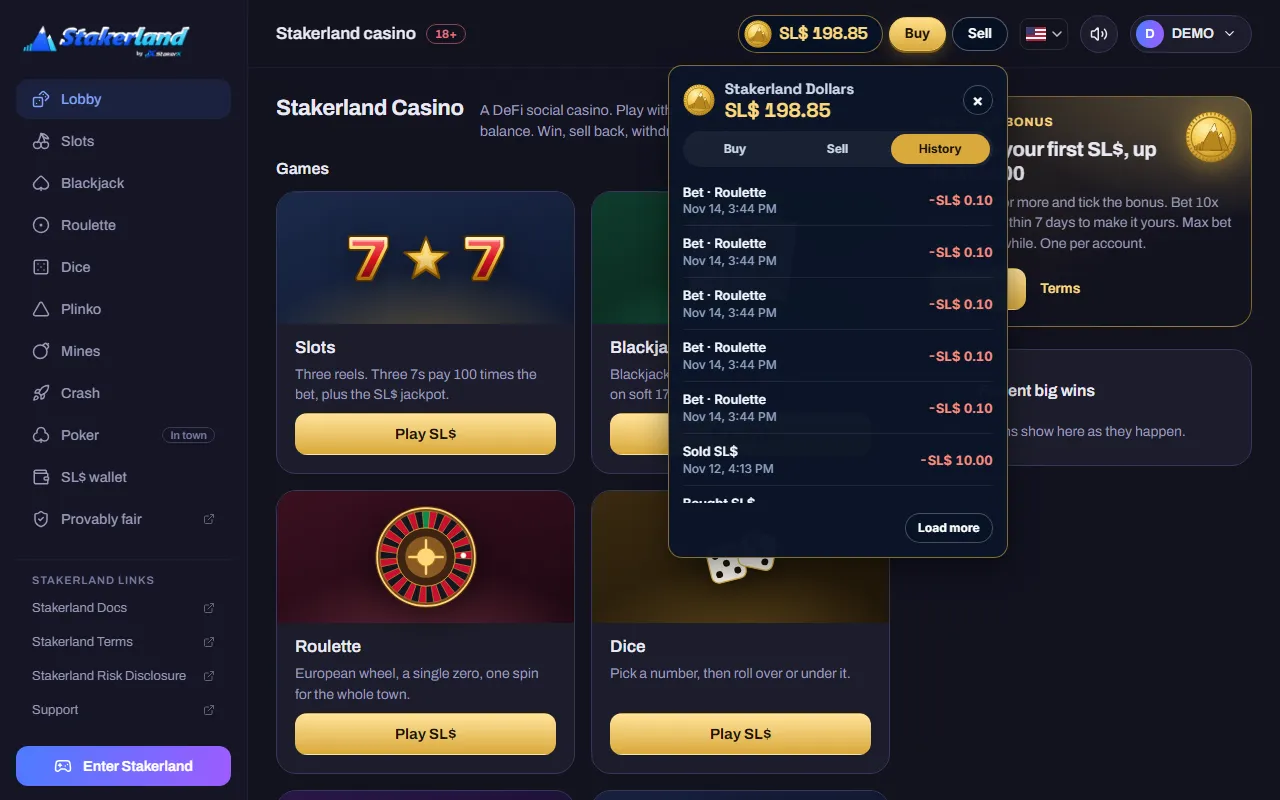
Click your SL$ balance at the top right, or the History tab in your wallet, to see your SL$ history: every purchase, sale, bet and win, newest first, with the date and time and the amount. Load more brings the next 30, all the way back to your first purchase.
A row from a game names it, such as Bet · Slots, Win · Roulette, Buy-in · Poker or Pool bet won.
Money in shows in green and money out in red. SL$ moving between your own pockets shows in white: a buy-in held at a poker or pool table and what comes back from it, or a sale waiting for approval.
Prize pools and the house cut
The slots, roulette, blackjack, Dice, Plinko, Mines and Crash are played against a prize pool for each game, funded by the players' own bets. On every bet a small house cut is taken up front, and the rest of the stake goes into that game's pool. Wins are paid from the pool.
A bet is accepted only when the pool can cover the most that bet could win. When it cannot, the game tells you the largest bet it can take right now. A win is never paid less than the paytable promises.
A game opens for SL$ once its pool holds its opening size. 0.25% of every SL$ slot bet builds a progressive jackpot, paid on three 7s on top of the line's 100 times the bet: all of it on a bet of SL$10 or more, and below that a share in proportion to the bet (a SL$1 bet wins a tenth of it, a SL$0.10 bet a hundredth). What is not won stays in the jackpot. Players fund it entirely.
Any of these games can be paused for SL$ for a while. A new SL$ bet is then refused with a message saying so, play chips still work, and a hand, spin or round already under way settles as usual.
Published returns
These are the same for every player. A return, a paytable or a cut changes only as an announced change, never per player and never because of anyone's results.
The return is what a game pays back on average over a very long run. The house cut comes out of the game's edge, not on top of it.
Every game plays by the same rules for SL$ as for play chips (see each game's section above). The slots pay by the same table too, about a 96% return: three 7s pay 100 times the bet, and two 7s pay 6.5 times.
| Game | Return and house edge | House cut, up front |
|---|---|---|
| Slot machines | 96% return, a 4% edge | 3.5% of each bet |
| Roulette | Single zero, a 2.7% edge | 2.2% of each bet |
| Blackjack | 3 to 2, dealer stands on soft 17: about a 0.5% edge with perfect play | 0.4% of each bet |
| Texas Hold'em | Between players, no house edge | 5% of each pot, and none when a hand ends before the flop. At most 1 big blind heads up, 2 with three or four players dealt in, 3 with five or six |
| Pool betting | Between players, no house edge | 8% of the pot |
| Dice | 99% return, a 1% edge | 0.8% of each bet |
| Plinko | 98.96% to 99% return, shown under each board | 0.8% of each ball |
| Mines | 99% return, a 1% edge, whenever you cash out | 0.8% of each round |
| Crash | 99% return, a 1% edge, whenever you cash out | 0.8% of each bet |
Provably fair play
Every result is decided on StakerX's servers, never in your browser. Each one comes from a server seed, your own seed (which you can change) and a counter, combined with HMAC-SHA256.
You see the server seed's fingerprint (its SHA-256 hash) before you play. When you rotate your seed, the old server seed is revealed, so you can check every past round yourself under Fair play. Blackjack shuffles a fresh shoe every round.
Roulette's wheel is shared, so each spin has its own server seed. Its fingerprint comes with every SL$ chip you place, and the seed itself is shown once the ball stops, so you can check the pocket yourself. SL$ chips stay on the board once placed, and if a spin never happens, they come back to your balance within the hour.
Dice, Plinko and Mines use your seeds in the same way, and their Fairness tab recomputes any past roll, drop or board in your browser. Mines places its mines by shuffling the 25 tiles, as the big crypto casinos do, so their checkers agree with ours.
Every crash point comes from a chain of 10,000,000 hashes made before the first round, used from the end backwards, and mixed with the hash of a Bitcoin block nobody knew when the chain was fixed. Each round's hash is shown once it has crashed: hash it to get the round before's, and check its crash point here.
Crash's chain today has 10,000,000 hashes and is salted with the hash of Bitcoin block 975,853. Its terminating hash and that block number were published on StakerX's GitHub before the block was mined.
Poker and pool for SL$
Poker and pool betting are played between players, not against the house. Sitting down at a poker table with SL$ moves your buy-in to the table, and getting up returns what is left. For a pool bet, both stakes are held when the game starts and the winner takes the pot, less the house cut.
Accounts that are linked to each other can play each other only with play chips. Collusion and chip dumping break the Stakerland Terms.
Play only what you can afford to lose
You can lose everything you play with. Outcomes are random, past results say nothing about the next one, and no strategy beats a game's edge over time.
Read the Stakerland Risk Disclosure before you buy SL$. It explains these risks in full.
Stakerland's own rules
Stakerland has its own Terms, which add to the StakerX Terms of Service. They cover who can enter, adult content and consent, the code of conduct, chat, safety tools and moderation, items, play chips, gift boxes and SL$. The Terms are binding; this guide only explains them.
The Stakerland Risk Disclosure sets out the risks of playing for SL$. Both are linked below.